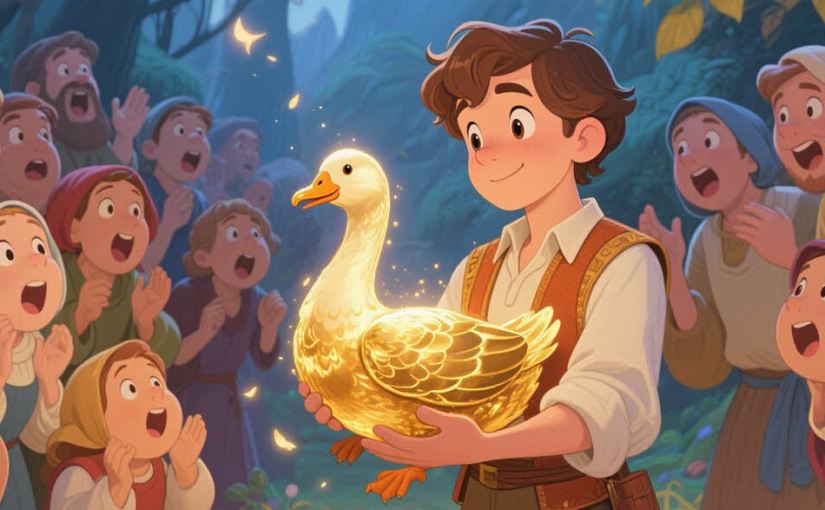
The Golden Goose – Free Simple Bilingual Story for Kids to Learn Spanish

Looking for a fun way to teach your child Spanish? Bilingual stories are one of the best methods to introduce a child gently to Spanish and make learning Spanish easy and fun. The more bilingual stories you read to your child, the more Spanish words they’ll naturally pick up and the faster they’ll understand and speak Spanish.

The Golden Goose / El Ganso de Oro

There was once a boy named Simpleton.
Había una vez un chico llamado Simpletón.

Everyone called him Simpleton because he was gentle and a little silly.
Todos lo llamaban Simpletón porque era amable y un poco distraído.

But he had a good heart.
Pero tenía un buen corazón.

He lived with his mother and two older brothers.
Vivía con su madre y sus dos hermanos mayores.

His brothers were proud and rude.
Sus hermanos eran orgullosos y groseros.

One day, their mother said, “Go into the forest and cut some wood.”
Un día, su madre dijo: “Vayan al bosque y corten algo de leña.”

Continue reading The Golden Goose – Free Simple Bilingual Story for Kids to Learn Spanish

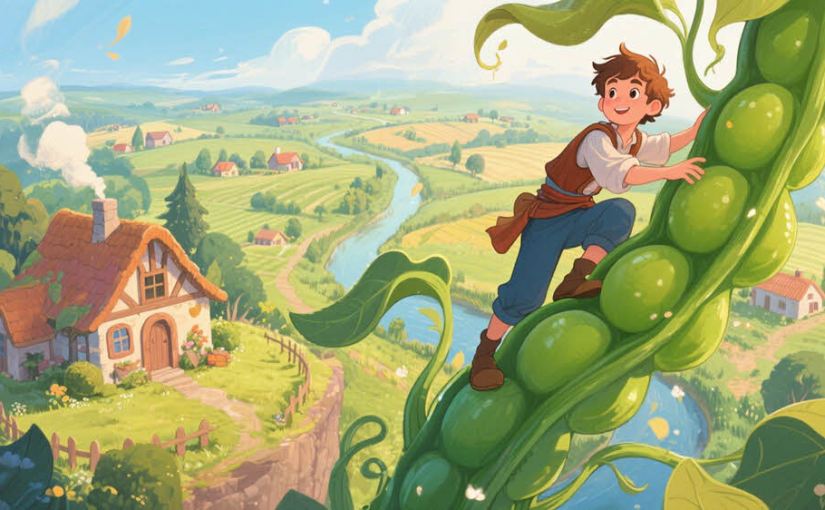
Jack and the Beanstalk – Free Simple Story in Spanish and English for Kids

Reading simple stories in Spanish and English is an easy way for Spanish beginners and kids to learn the language without effort. Simply read the short story and absorb the new Spanish vocabulary. To reinforce the words you picked up and keep improving your Spanish, read a short bilingual story each day.

Jack and the Beanstalk / Jack y la Habichuela Mágica

Jack lived with his poor mother.
Jack vivía con su madre pobre.

They had no money left.
No les quedaba dinero.

Their cow gave no more milk.
Su vaca ya no daba leche.

Jack’s mother said, “Take the cow to market.”
La madre de Jack dijo: “Lleva la vaca al mercado.”

“Sell her for a good price.”
“Véndela por un buen precio.”

Jack walked with the cow down the road.
Jack caminó con la vaca por el camino.

Soon he met a strange old man.
Pronto encontró a un anciano extraño.

“I will give you five magic beans for your cow,” the man said.
“Te daré cinco frijoles mágicos por tu vaca,” dijo el hombre.

“Magic beans?” Jack asked.
“¿Frijoles mágicos?” preguntó Jack.

“Yes! Very powerful!”
“¡Sí! ¡Muy poderosos!”

Jack traded the cow for the beans.
Jack cambió la vaca por los frijoles.

Continue reading Jack and the Beanstalk – Free Simple Story in Spanish and English for Kids

Snow White / Blancanieves – Bilingual Short Story for Learning Spanish Free

Enjoy a free, simple short story in Spanish and English for language learners and kids! Learning Spanish with bilingual stories is easy and fun. It’s a great, stress-free way to expand your Spanish vocabulary and improve your Spanish skills.

Snow White / Blancanieves

Snow White was a girl with skin white as snow.
Blancanieves era una niña con la piel blanca como la nieve.

Her hair was black as night.
Su cabello era negro como la noche.

And her lips were red as a rose.
Y sus labios eran rojos como una rosa.

She lived with her stepmother, the Queen.
Vivía con su madrastra, la Reina.

The Queen had a magic mirror.
La Reina tenía un espejo mágico.

Continue reading Snow White / Blancanieves – Bilingual Short Story for Learning Spanish Free

How to Teach Your Kid Spanish Vocabulary with Free Fun Word Search Games

Teaching Spanish vocabulary to kids is one area where parents often feel stuck. It is easy to assume that vocabulary learning must involve drills or memorization, because that is how most of us were taught languages in school.

But children learn in the opposite way.

Their brains thrive on play, movement, discovery, and fun challenges.

The more a child enjoys an activity, the more their memory opens up and absorbs new Spanish words naturally.

That is why Spanish word games for kids are so effective. They give the brain exactly the kind of stimulation it loves. No stress. No pressure. No guilt. Just exploration, curiosity, and small moments of pride with each new Spanish word discovered.

In this guide, we’ll share how best to use word puzzle games, in what order, when, and how much in order to teach your kid Spanish vocabulary in a way that’s fun, easy, and sticks in their memory.

Continue reading How to Teach Your Kid Spanish Vocabulary with Free Fun Word Search Games

How to Easily Teach Spanish to Your Child Based on Their Learner Type

If you’re trying to teach your child Spanish and ever wondered they light up sometimes and tune out other times, it might not just be about mood or interest. It might be about how their brain is wired to learn.

Understanding your child’s learning style can make a massive difference in how well they absorb Spanish, how fast they learn it, how much they struggle, or how much they enjoy it.

Some kids learn Spanish best by seeing. Others by hearing. Others by doing, touching, or moving.

The good news? There are methods that work for all of them. And in this guide, we’ll break it all down.

Continue reading How to Easily Teach Spanish to Your Child Based on Their Learner Type

The Science Behind Bilingual Stories for Teaching a 7-Year-Old Spanish

If you’ve ever tried teaching your 7-year-old Spanish and watched their eyes glaze over after ten flashcards or one grammar lesson, you already know something’s off.

Maybe you downloaded a vocab app with bright colors, a cute squirrel, and silly sounds. Maybe you printed colorful worksheets full of conjugation tables. Or maybe you bought a Spanish grammar workbook designed for kids.

And maybe, just maybe, you found yourself thinking, “Even I find this boring… how is my 7-year-old supposed to enjoy it?”

The truth is, they probably won’t. And science is on their side.

There’s a better way to teach Spanish. A way that’s more fun and far more effective, especially at age 7.

It’s called bilingual story learning. And it works better than Spanish lessons, drills, grammar rules, and isolated vocab lists because it works with your child’s brain and development stage, not against it.

Let’s dig into why.

Continue reading The Science Behind Bilingual Stories for Teaching a 7-Year-Old Spanish

How to Turn Your Child Into Your Spanish Teacher (And Why It Works Better Than Traditional Lessons)

A Silly, Brilliant, Confidence-Boosting Way to Learn Spanish Together

Some children freeze the moment Spanish feels like a “lesson”. The moment a parent holds Spanish flashcards in one hand and has that polite “okay sweetheart, what’s this word” voice, kids tighten up. Suddenly it feels like a test. And tests make small shoulders heavy.

Yet those same children light up the moment the roles flip and they get to be the Spanish teacher. Kids love having power. They love instructing, correcting, explaining, and being the “expert” for a change. It feels exciting. It feels grown up. And it removes all the pressure from learning Spanish.

So here’s the secret technique that parents don’t realize is a superpower:
Let your child become your Spanish teacher.

Yes. Let them stand on a chair, hold a clipboard, wear glasses they don’t need, and announce, “Good afternoon, class.” Let them grade your worksheets. Let them quiz you on flashcards. Let them circle the words in the word search while you pretend to struggle spectacularly.

They will learn more Spanish while pretending to teach you than they ever learned from being tested or drilled by you.

Let’s talk about how to do this in a fun, silly, structured way, and why the psychology behind it works so incredibly well.

Continue reading How to Turn Your Child Into Your Spanish Teacher (And Why It Works Better Than Traditional Lessons)

Turning Bedtime Stories Into Spanish Lessons (Without Your Child Noticing)

Discover how to turn nightly bedtime stories in Spanish (or bilingual stories) into natural language learning without effort, stress, or boring lessons.

Most parents read bedtime stories to relax their kids. A warm blanket, a familiar voice, and a world of imagination. It’s the classic nighttime routine. But what if those cozy tales could secretly teach your child Spanish, without a single quiz, worksheet, or lesson plan?

Turns out, they absolutely can.
And bedtime is the perfect moment to sneak Spanish into your child’s brain, softly and powerfully.

In this guide, you’ll learn how reading bilingual English-Spanish kids stories at night transforms into real language absorption using proven neuroscience, emotional connection, and zero stress.

Continue reading Turning Bedtime Stories Into Spanish Lessons (Without Your Child Noticing)

How to Measure Your Child’s Spanish Progress with Bilingual Stories

If you’re teaching your child Spanish at home, you might wonder:
Is it working? Are they really learning?

When you skip flashcards, grammar drills, and stressful testing in favor of bilingual stories, tracking progress might feel less obvious. But make no mistake: your child is learning, and the signs are easy to spot once you know what to look for.

In this guide, we’ll walk through how to measure your child’s Spanish learning progress using bilingual stories.

Whether you’re using bedtime tales, storytime rituals, or audio stories on the go, this article will give you a clear month-by-month roadmap to see results, without pressure or tests.

We’ll also cover the science behind story-based learning, common parent questions, and why this method is one of the easiest, most brain-friendly ways to teach kids Spanish naturally.

Continue reading How to Measure Your Child’s Spanish Progress with Bilingual Stories

Why Your 7-Year-Old Forgets Spanish (And How to Fix It)

If you’ve ever spent a whole week practicing Spanish with your 7-year-old, only to hear them blank out or shrug when you ask, “What does gato mean again?” you’re not alone.

It can feel like you’re pouring water into a bucket with a hole in the bottom. They seem to understand in the moment, but by the next day? Gone. Poof. Vanished.

So, is something wrong? Are they too distracted? Too young? Not trying hard enough?

Actually, it’s none of those things. There’s a much better, science-backed explanation and an even better fix. And it starts with a part of your child’s brain that’s still under construction at age 7.

Continue reading Why Your 7-Year-Old Forgets Spanish (And How to Fix It)

Why Kids Refuse Learning Spanish and How to Make Them Fall in Love with It and Beg for More

If you’re a parent trying to teach your child Spanish and they’re refusing, saying it’s boring, they don’t want to learn it, or outright telling you they hate Spanish and asking you to speak English instead, you’re not alone. This happens in countless households.

Whether your child grew up with Spanish from birth or you’re introducing it later, resistance can hit hard. You might feel frustrated, rejected, or even worried. But there’s a reason behind this refusal, and more importantly, there are gentle, joyful ways to turn things around.

Whether you’re a Spanish-speaking parent hearing those words from your child, or you’re a non-Spanish-speaking parent trying to introduce the language at home, this can feel disheartening. You want your child to connect with their roots. Or become bilingual. Or at least be open to new cultures and opportunities. But when the response is all resistance, what then?

This article will walk you through why kids resist Spanish in the first place, what traditional approaches often get wrong, and how to flip the script. Instead of begging your child to practice Spanish, you can get them asking for more… often without realizing they’re learning at all.

Continue reading Why Kids Refuse Learning Spanish and How to Make Them Fall in Love with It and Beg for More

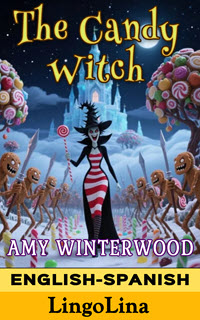
Sneak peek: First Two Chapters of ‘The Candy Witch’ Bilingual Story for Kids

Enjoy the first chapter of our latest bilingual fantasy story book, The Candy Witch, for kids ages 6-12.

Candy Witch English-Spanish Parallel Text Story for Kids to Learn SpanishOn a stormy winter night, Roy is minding his own business… until an enchanted snowflake floats into his room and whisks him away to a frozen land above the clouds.
Now he’s stuck in a sugary nightmare with hypnotized kids, flute-playing mice, a sinister Candy Witch, and gingerbread soldiers who want to eat him alive.

It’s funny. It’s creepy. It’s packed with action.
And it teaches your child Spanish sentence by sentence while keeping them glued to the page.

Here’s your chance to read the first two chapters for free!

Continue reading Sneak peek: First Two Chapters of ‘The Candy Witch’ Bilingual Story for Kids

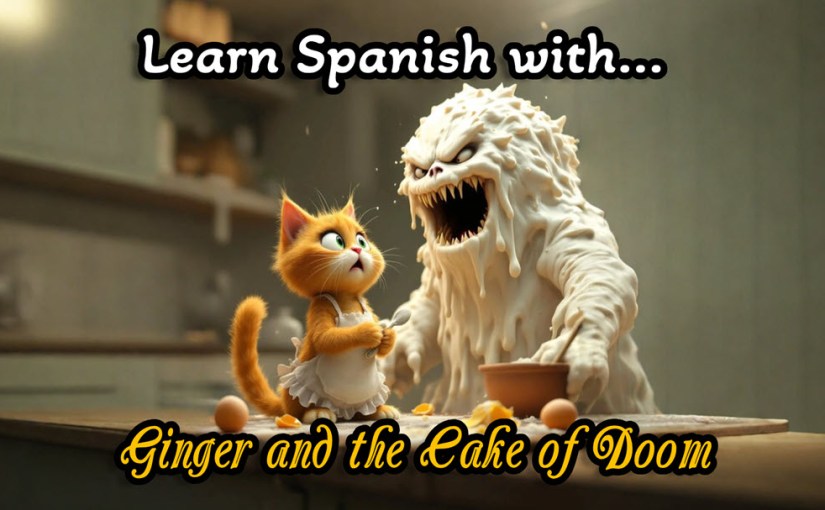
How to Teach Your Child Spanish in a Fun, Natural Way with ‘Ginger and the Cake of Doom’

A flying cat, a vengeful cake, and a rescue mission across space… this is one Spanish lesson your kids will actually beg for.

What if learning Spanish felt like a wild adventure instead of a boring lesson?

Imagine your child laughing at a brave flying cat chasing a possessed cake through outer space, without realizing they’re also learning a new language.

That’s the magic of Ginger and the Cake of Doom by Lily Galili, a bilingual fantasy story from LingoLina that helps kids learn Spanish naturally through imagination, emotion, and laughter.

It’s one of those rare books that kids can’t put down, and parents secretly also enjoy just as much.

Continue reading How to Teach Your Child Spanish in a Fun, Natural Way with ‘Ginger and the Cake of Doom’

Why Bilingual Books Are the Easiest and Most Fun Way for Kids to Learn Spanish

Every parent who’s ever tried to teach their child Spanish knows the frustration. Flashcards don’t stick, grammar drills cause groans and yawns, and language apps often feel like more schoolwork.

You want your child to enjoy learning Spanish, not dread it. The good news? There’s a gentler, smarter way: through fun stories.

Bilingual fiction books for kids in Spanish and English turn language learning into an adventure. Instead of memorizing words, kids pick them up naturally as they follow a magical tale.
It feels like storytime, not study time.

Continue reading Why Bilingual Books Are the Easiest and Most Fun Way for Kids to Learn Spanish