
If you’ve ever tried teaching your 7-year-old Spanish and watched their eyes glaze over after ten flashcards or one grammar lesson, you already know something’s off.
Maybe you downloaded a vocab app with bright colors, a cute squirrel, and silly sounds. Maybe you printed colorful worksheets full of conjugation tables. Or maybe you bought a Spanish grammar workbook designed for kids.
And maybe, just maybe, you found yourself thinking, “Even I find this boring… how is my 7-year-old supposed to enjoy it?”
The truth is, they probably won’t. And science is on their side.
There’s a better way to teach Spanish. A way that’s more fun and far more effective, especially at age 7.
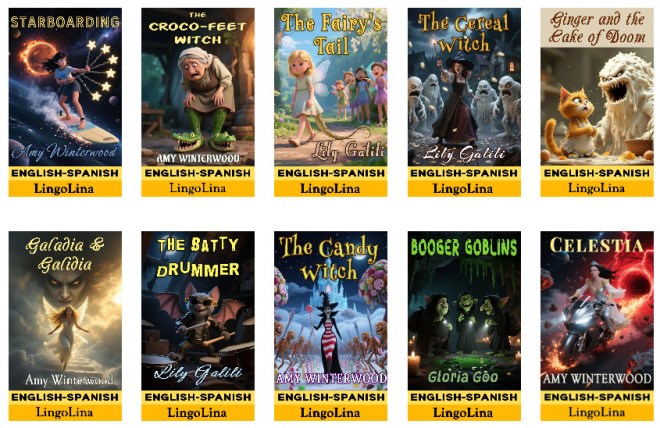
It’s called bilingual story learning. And it works better than Spanish lessons, drills, grammar rules, and isolated vocab lists because it works with your child’s brain and development stage, not against it.
Let’s dig into why.
Why 7-Year-Olds Struggle with Spanish Flashcards, Vocabulary Drills, and Grammar Lessons
Most traditional tools used to teach Spanish are designed by academics, for academics, not normal humans, and certainly not kids. And even adults often give up out of overwhelm, frustration, and boredom.
Spanish vocab drills, grammar tables, and flashcards might work in short bursts, but they rely on short-term memory, repetition without context, and dry, abstract rule memorization.
For a 7-year-old who is still learning how to manage focus, switch attention, and retain abstract information, these tools are confusing, frustrating, and downright demotivating.
Grammar requires logical thinking, working memory, and pattern tracking. Your 7-year-old’s brain is still wiring up the connections needed for all of that. These systems are growing rapidly but are far from mature. That means asking your child to memorize verb tables is like asking them to write a symphony before they can hum a tune.
Spanish learning flashcards and vocab drills? They bombard your kid with disconnected words that float around in their head with no anchor. It’s like giving them puzzle pieces without the picture on the box.
The result? They forget. They tune out. They tell you they don’t like Spanish. But it doesn’t have to be that way.
The Science Behind How Bilingual Stories Teach Kids Spanish
When your child hears or reads a story, something amazing happens in their brain.
In one fascinating MRI study, researchers found that when someone reads a story involving action or movement, the motor and visual areas of the brain actually light up. Their brain behaves like they’re physically experiencing the story! Even though they’re not moving or seeing anything themselves. Why? Imagination does that.
So when your 7-year-old hears: “The princess rode the blue dragon over the forest. Its wings flapped loudly around her ears. The cold wind howled in her ears. She tightened her grip around him, and clung to his back with all her might.”
Their brain imagines riding the dragon, the flying, the wind, the color blue, and the forest. That gets stored as a kind of mini memory. And if they hear it in English and then in Spanish right after, their brain automatically links the sounds of the Spanish words to the meaning they just imagined.
Even better? Another study showed that the same parts of the brain that recall actual memories also activate when we imagine something vividly. That means when your child imagines a story scene, their brain files it away in the same way it would store something that actually happened.
That’s powerful. Because, according to Stanford psychologist Jennifer Aaker, when a new Spanish word or sentence is stored alongside imagery, emotion, and imagination, the brain can remember it up to 22 times better.
Best of all, stories work beautifully for every type of learner. Harvard psychologist Vanessa Boris notes that about 40 percent of people are visual learners who absorb information through images, videos, or vividly imagined scenes. Another 40 percent are auditory learners who learn best through listening and conversation. The remaining 20 percent are kinesthetic learners, who understand things most deeply by doing, experiencing, or feeling.
Storytelling works for all three groups at once: visual learners get mental pictures; auditory learners tune into the words and rhythm of the storyteller’s voice; kinesthetic learners connect through emotion and atmosphere.
No flashcard in the world can do that.
Bilingual Stories Are Like Natural Spanish Immersion With Built-In Meaning
Immersion sounds ideal in theory. But in practice, pure Spanish-only learning can leave a 7-year-old completely lost. If they don’t understand what they’re hearing or reading, their brain tunes out. They can’t grab meaning from thin air.
What they need is comprehensible immersion. That means hearing Spanish, but with meaning already known. Bilingual stories deliver this perfectly.
With LingoLina’s NeuroFluent paired sentence approach, first, they hear the sentence in English, so they understand exactly what’s happening. Then they hear it again in Spanish. No guessing. No confusion. Their brain hears a new Spanish sentence and instantly knows what it means. Over time, it builds deeper and stronger links between sound, meaning, and usage.
This mirrors how babies learn language. A baby sees their parent point to a dog and say “dog,” over and over, until the connection is made. A child who is blindfolded and deaf would lack context and would struggle to link the sounds to meaning. That’s what it’s like when a child hears only 100% Spanish immersion full of words they don’t understand. They’re blindfolded to meaning.
But with bilingual stories, every Spanish sentence is wrapped in context. It’s not just immersion. It’s immersion with sights, sounds, emotions, and exciting experiences that their brain files away as powerful memories.
Why Bilingual Stories Teach Kids Spanish Faster than Grammar Lessons
When you use English-Spanish stories with your 7-year-old, you’re building far more than Spanish vocabulary completely naturally. You’re wiring their brain for Spanish across every major skill area.
They’re building Spanish listening comprehension as they hear you read aloud or listen to the audiobook version. They learn to follow Spanish at a natural pace, without slowing it down word by word.
They’re getting natural Spanish accent training by hearing proper Spanish rhythm, intonation, and pronunciation from fluent readers. Even if they don’t speak yet, their ear is getting trained.
They’re improving Spanish reading comprehension as they see new Spanish words and full Spanish sentences tied to meaning. Over time, they’ll begin recognizing patterns and predicting meaning on their own.
They absorb correct Spanish spelling from seeing the words again and again in print. Unlike vocab lists, these words are anchored to meaning, so they stick.
They pick up more Spanish vocabulary simply because stories expose them to far more words than drills ever do. And the words appear in rich, meaningful settings, not as isolated labels.
They remember those Spanish words longer because they are tied to imagination, visuals, and emotion—which are all stored in long-term memory. That’s the kind of deep encoding that lasts.
They acquire Spanish grammar the way native speakers do: by hearing full sentences in real contexts. They learn how Spanish works from patterns, not from rules. And because the story scenes are memorable, the grammar inside those sentences gets remembered too.
They build Spanish fluency through repetition and rhythm. As they hear and repeat lines, their mouth gets used to forming Spanish words and their brain gets faster at finding them.
And they even develop strong bilingual switching skills. Because every sentence has both English and Spanish, their brain learns to separate the two languages clearly. They know exactly which word belongs to which language because they saw and heard them paired. That’s very different from flashcards or vocab apps that bounce between languages and often confuse kids.
Questions Parents Ask about Learning Spanish through Stories
Will bilingual stories confuse my child and make them mix up languages? No. In fact, they help your child separate the languages. Because each sentence has both English and Spanish in a clear pattern, your child builds parallel tracks in their brain. They learn which word belongs to which language, with meaning as the guide.
For how long do I need to provide the English sentence first? As long as needed. Once your child understands 80% or more of the Spanish they hear, you can switch to Spanish-only stories or alternate between both versions. The English is there to build comfort and comprehension.
What if I don’t speak Spanish? Can I still read bilingual stories to my child? Absolutely. You can read it yourself or play the audiobook. Your child hears both. Many parents even begin learning Spanish themselves this way, side-by-side with their child.
Can I teach my child Spanish if I don’t know it myself? Yes. In fact, story-based learning makes that not only possible but fun. You’re not the teacher. You’re the reading buddy. You guide the experience, listen with them, and enjoy the journey together.
Give Bilingual Stories a Week, You Might Never Go Back to Traditional Spanish Lessons
The next time you feel tempted to reach for the flashcards or cue up a grammar app, try something new. Pick a fun bilingual story instead. One with short, clear English and Spanish sentence pairs. One that your 7-year-old will actually want to hear again.
Read the story with them. Let them act it out. Let them giggle at the silly parts or whisper their favorite line in Spanish. Watch how their brain lights up, how their Spanish vocabulary builds, how their confidence grows.
And before long, they won’t just be learning Spanish.
They’ll be living it. And loving it.
References
Aaker, J. (n.d.). Harnessing the power of stories. Stanford VMware Women’s Leadership Innovation Lab. https://womensleadership.stanford.edu/resources/voice-influence/harnessing-power-stories Women’s Leadership Innovation Lab+1
Boris, V. (n.d.). What makes storytelling so effective for learning? Harvard Business Impact. https://www.harvardbusiness.org/insight/what-makes-storytelling-so-effective-for-learning/

 LingoLina