Teaching Spanish vocabulary to kids is one area where parents often feel stuck. It is easy to assume that vocabulary learning must involve drills or memorization, because that is how most of us were taught languages in school.
But children learn in the opposite way.
Their brains thrive on play, movement, discovery, and fun challenges.
The more a child enjoys an activity, the more their memory opens up and absorbs new Spanish words naturally.
That is why Spanish word games for kids are so effective. They give the brain exactly the kind of stimulation it loves. No stress. No pressure. No guilt. Just exploration, curiosity, and small moments of pride with each new Spanish word discovered.
In this guide, we’ll share how best to use word puzzle games, in what order, when, and how much in order to teach your kid Spanish vocabulary in a way that’s fun, easy, and sticks in their memory.
Why Spanish Word Games Build Better Vocabulary Than Flashcards
Spanish flashcards are one of the oldest vocabulary tools. They do have their place. They can help review simple categories like colors, animals, numbers, foods, and daily objects.
But flashcards rely on short-term memory, not long-term memory. A child must stare at a picture and repeat the Spanish word many times. They may recall it for a day or two, but the memory fades quickly because there is no emotional anchor or real-life use of the word.
Word games work differently. Searching for a word, spotting it in a puzzle, solving a clue, or matching it to a picture creates a mild challenge that wakes up the brain. It becomes a tiny adventure. The moment the child finds the word, dopamine rises and the memory strengthens. This turns language practice into a satisfying experience instead of a chore.
Flashcards can be helpful, but if you use them, use them sparingly and always after your child has encountered the word in a bilingual story or in a meaningful context.
A Spanish vocabulary flashcard should include a colorful illustration or image and be used to review something the child already knows, not introduce something brand new. That reduces pressure and increases retention.
A great rhythm is: bilingual story first, game second, flashcard last. This keeps learning grounded in meaning, reinforced in play, and lightly reviewed at the end.
Why Word Search Games Work So Well with Bilingual Stories
Teaching your child Spanish through bilingual stories is incredibly powerful.
Kids pick up dozens of new words simply by reading or listening to bilingual English-Spanish stories, even if they are absolute beginners.
The tricky part is that their Spanish vocabulary grows quietly over time. It is not always obvious how many new words your child has learned or how fast their Spanish “word bank” is expanding.
Many parents want a simple way to reinforce new Spanish words, measure progress, and feel confident that the vocabulary is sticking. Some even like tracking how many Spanish words their child learns per day or per week. Others simply want a structured activity that supports memory, without turning the experience into homework.
This is where LingoLina’s free printable word search activity sheets become the perfect companion to your child’s reading routine.
They feel like play, not study. They reinforce Spanish words from the story. They help you see progress more clearly. And most importantly, they make language practice something your child genuinely enjoys.
Let’s walk through how to use them, why they work, and how they fit beautifully into your daily Spanish learning routine.
Why Word Search Games Help Kids Remember Spanish Words Faster
Children love looking for patterns. Their brains naturally enjoy scanning, spotting, circling, and discovering hidden words.
A word search puzzle activates a different kind of focus than reading or passive listening alone. It is playful, visual, and self-paced, which means there is no pressure. The child feels clever and capable each time they find a word.
This boosts confidence. Confidence boosts motivation. Motivation boosts learning.
Unlike flashcards or quizzes, a word search puzzle (connected to a story they just read) strengthens vocabulary without the stress of “studying”. The child sees familiar words from the story, remembers the scenes or characters, finds the matching Spanish spelling, and builds memory through repetition.
Every time a child finds a word, several parts of the brain light up at once. The visual centers, the pattern recognition circuits, and the language comprehension areas all work together.
The story provided the meaning, and now the puzzle reinforces it in a more deliberate way.
This combination makes words stick longer and deeper.
Why Bilingual Story First, Word Puzzle Second Is the Ideal Learning Order
A word search puzzle is most effective after your child has already heard or read a story where those words appeared.
The bilingual story gives the word context, emotion, and meaning. Your child knows what corazón or gato refer to because they experienced them inside the plot. Without this emotional anchor, a word search becomes just a grid of letters.
But after the story, everything changes.
Now each Spanish word is tied to a character, a scene, a feeling, or a moment. The puzzle reactivates the memory. The connection becomes stronger. This is exactly how long-term vocabulary develops.
Reading the bilingual story gives the brain meaning. Doing the word search afterward strengthens recall. Both activities support each other and create a gentle, natural learning loop.
How to Use the Free LingoLina™ Word Search Sheets Step by Step
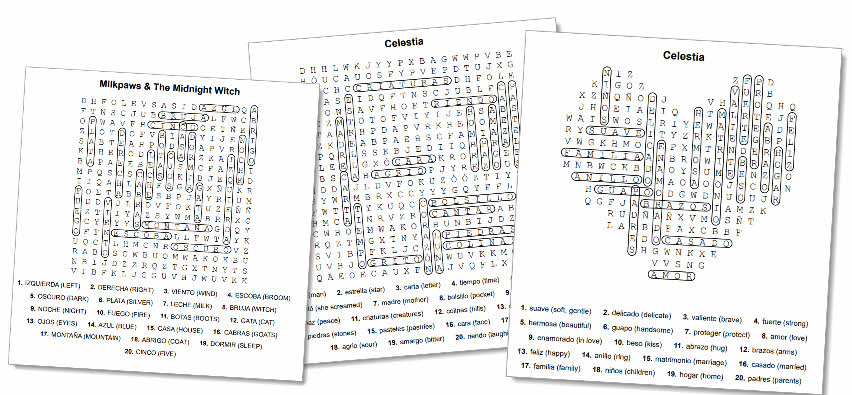
Start by reading a chapter or a section of one of our bilingual Spanish-English stories. If you are using the audiobook, listen together with your child for a few minutes. Let the story settle in. Let the child enjoy the adventure. Never rush.
Then open the matching word puzzle activity sheet for that book. (You can download all of them for free over here.)
Let your child hunt for the Spanish words at their own pace. They do not need to find every word in one sitting.
Let it be fun. If they want to take a break, that is perfectly fine.
You can encourage them by sitting beside them and searching together. Some families love turning it into a small, friendly contest. Who will find the first Spanish word? Who will find the longest word?
If your child finds a tricky word, celebrate it. You can say things like, “You found it. Look at you, that is really smart.” These small moments of praise boost pride and motivation, which lead to even more curiosity and skill-building.
The goal is not perfection. The goal is joy, repetition, recognition, and confidence.
How to Use All Five Spanish Worksheets for Each Bilingual Story Without Overwhelm
Each LingoLina™ story comes with multiple activity sheets. This gives you a whole week of gentle reinforcement. The key is not to use all five worksheets in one day. That would be overwhelming, and your child would get tired.
Here is a simple rhythm that works beautifully:
Day one: read a chapter, use one sheet.
Day two: read the next section, use another sheet.
Day three: listen to the audiobook version, do a third sheet.
Day four: reread a favorite part and do the fourth sheet.
Day five: finish the final activity sheet for the week along with another activity like drawing, role-play, or puppet theater.
This creates a steady learning cycle without stress. New Spanish words are encountered naturally in stories, then reinforced in word puzzles, then heard again when listening. The brain loves this kind of spaced repetition.
If you return to the same bilingual story weeks or months later, you can print the activity sheets again. Even if your child remembers some of the words, they almost certainly will not remember where they were hidden in the puzzle. The result is fresh excitement and another round of vocabulary reinforcement.
Every revisit deepens the memory of the new Spanish vocabulary.
Why Spanish Word Searches with Translations Work Better Than Spanish-Only Puzzles
Many printable Spanish word search games online only include the Spanish vocabulary list. Parents often assume this is “better” because it forces the child to recall the meaning without help. But this usually backfires.
The child stares at an unfamiliar word with no clue what it means or where they learned it.
Confusion rises. Motivation drops. Stress quietly creeps in.
Spanish suddenly feels “too hard”.
That is why LingoLina’s word search activity sheets display the Spanish word together with the English translation. This removes the guesswork and gives your child instant comprehension and purpose.
They see the meaning. They remember the scene where the word appeared. They know exactly what they are searching for. Their confidence rises instead of shrinking.
Removing confusion is one of the fastest ways to keep a child engaged. When the mind relaxes, learning accelerates.
A relaxed child finds twice as many words as a frustrated one. Translation next to each word keeps vocabulary learning clear, smooth, and enjoyable.
When Spanish Vocabulary Games Become Too Hard: Signs of Overwhelm to Watch For
Children rarely tell you directly when Spanish feels overwhelming. Instead, you will notice small signs:
They hesitate to begin.
They wiggle uncomfortably or get easily distracted.
They stare at the page without searching.
They sigh or say “I can’t find it” before trying.
They ask to do something else.
Their energy drops suddenly.
They look frustrated or defeated.
These are early cues that the activity has crossed the line from fun into effort. It is important to stop before the child reaches this point. Once frustration takes over, the brain closes down and learning slows dramatically.
If you spot these signs, gently pause. You can say something like, “Let’s finish this word together and save the rest for tomorrow.” This keeps the mood positive and protects your child’s long-term relationship with Spanish.
The goal is to stop while the experience still feels playful, not after the child is drained.
How Much Spanish Vocabulary Practice Is Enough for Kids?
Parents often wonder how much vocabulary practice their child needs.
The truth is, children learn better from small, frequent doses rather than long sessions. Ten minutes of joyful searching builds more vocabulary than forty minutes of tired memorization.
A simple, effective rhythm is:
Read or listen to a story.
Do one short vocabulary activity.
Praise the effort, stop early, and continue tomorrow.
Instead of squeezing as much learning as possible into one session, spread it across the week. This is healthier for the brain, kinder to the child, and better for memory.
How Word Games Build Spanish Reading Skills Automatically for Kids
Searching for Spanish words helps children learn spelling patterns, accent marks, vowel sounds, and letter combinations without any formal instruction. The child simply sees these patterns again and again, the same way they see English spelling patterns through books.
Word searches improve scanning speed.
Matching clues to words improves comprehension.
Looking for the same word in multiple puzzles strengthens recognition.
Seeing the Spanish spelling repeatedly trains the eye faster than worksheets.
Spelling becomes automatic through repetition, not memorization.
Why Repeated Words Across Multiple Puzzles Are Good for Learning
You may notice that certain Spanish words appear in more than one worksheet. This is intentional and very helpful for learning.
Repetition is the foundation of long-term memory. When a word returns in a new puzzle or in a new chapter, the brain strengthens the neural pathway connected to that word. It is the same principle as riding a bike. The more times your child encounters a word in different contexts, the more automatic it becomes.
So if noche, padre, or casa show up again, that is excellent progress.
It means your child will remember them far longer and with much more confidence.
How to Combine Word Searches with Audiobooks and Re-Reading
Reading and listening together creates a double reinforcement effect. The audiobook trains the ear. The text trains the eyes. The puzzle trains visual recognition and memory.
Here are a few ways to combine them:
Listen to the chapter again while your child completes the puzzle.
Re-read the story at bedtime and do the puzzle the next day.
Let your child listen while coloring the found words.
Play the Spanish-only audio after the bilingual version to train their ear.
Combining formats builds robust comprehension. Words that might have slipped away become more familiar with each pass.
FAQ About Teaching Kid Spanish with Word Search Games
Do I have to read the story before we do the puzzle
It’s best because the story gives the vocabulary meaning, the puzzle reinforces how the word is spelled and its meaning.
Is it okay to use the answer key
Of course. Kids love checking their guesses. It builds confidence.
If your child can’t find the words, it’s better not to exhaust them hunting for them as that can make them feel frustrated. Instead, use the answer key as an activity in itself. Kids can color each word in a different color, turning it into its own little word search game even if the words are already circled.
Can we repeat the same Spanish word game weeks later
Yes. Repeating the word puzzles reinforces Spanish vocabulary beautifully.
Should I correct my child while they play
Keep it gentle. Encouragement works far better than correction.
My child gets frustrated with Spanish worksheets. What should I do?
Do fewer words per session. Let them skip words. Keep the mood light.
Read more bilingual stories with fewer worksheets for starters.
Are Spanish word puzzle worksheets enough to teach kids Spanish?
It is one part of a natural, immersion-based routine. The bilingual story is the main learning tool. The puzzle is the reinforcement tool.
Conclusion: Teach Kids Spanish Words the Fun Way
Teaching kids Spanish should feel relaxed, joyful, and natural. Bilingual stories give your child a world of experiences, sights, sounds, vivid memories, and clear meaning. Word search puzzles give them a sense of achievement and mastery, reinforcing new Spanish words they learned. Together they create a smooth vocabulary-building loop that feels like play instead of schoolwork.
With just a few minutes a day, your child absorbs new Spanish words, reinforces what they hear, and builds a growing language foundation that genuinely lasts and turns into fluency over time.
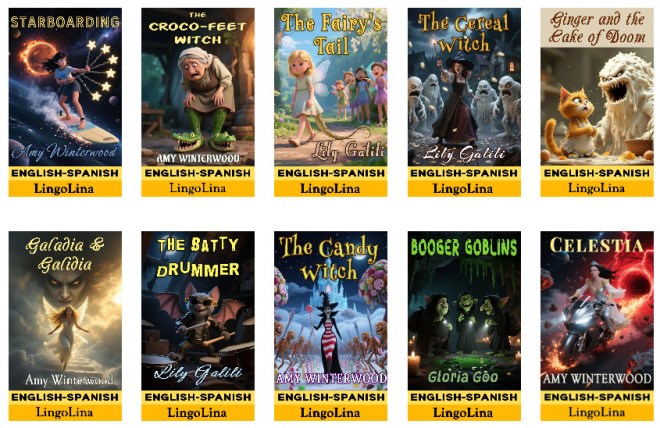
Try one of our fun bilingual stories today, and download our free word search puzzles here.

 LingoLina