A Silly, Brilliant, Confidence-Boosting Way to Learn Spanish Together
Some children freeze the moment Spanish feels like a “lesson”. The moment a parent holds Spanish flashcards in one hand and has that polite “okay sweetheart, what’s this word” voice, kids tighten up. Suddenly it feels like a test. And tests make small shoulders heavy.
Yet those same children light up the moment the roles flip and they get to be the Spanish teacher. Kids love having power. They love instructing, correcting, explaining, and being the “expert” for a change. It feels exciting. It feels grown up. And it removes all the pressure from learning Spanish.
So here’s the secret technique that parents don’t realize is a superpower:
Let your child become your Spanish teacher.
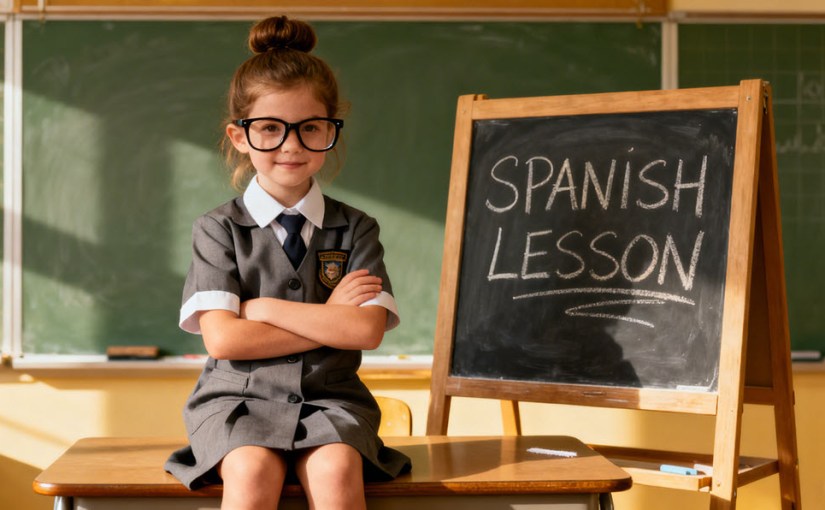
Yes. Let them stand on a chair, hold a clipboard, wear glasses they don’t need, and announce, “Good afternoon, class.” Let them grade your worksheets. Let them quiz you on flashcards. Let them circle the words in the word search while you pretend to struggle spectacularly.
They will learn more Spanish while pretending to teach you than they ever learned from being tested or drilled by you.
Let’s talk about how to do this in a fun, silly, structured way, and why the psychology behind it works so incredibly well.
Create a Teacher Persona Kids Can Step Into
Give your child a “teacher identity”. Kids love stepping into characters. It activates imagination and lowers inhibition.
You can invent a name together. Suggestions:
Professor Mariposa
Señor Don Taco
Mrs. Petunia
Captain Lengua
Doctora Luna
Maestro Pepito
Miss Peppermint
Set the tone. A pair of pretend glasses, a scarf, a cardigan, a silly hat, or even a ladle used as a pointer stick is enough to trigger imagination. Kids instantly feel “in character”. Once they enter that role, their brain shifts into engagement mode. They’re no longer a child learning Spanish. They’re the professional who knows everything, and you’re the nervous student.
Give Your Child Spanish Flashcards and Let Them Quiz You
Instead of quizzing your child, let them quiz you. Let them hold the flashcards. Let them wiggle one eyebrow suspiciously while asking, “And what is gato, hmm?”
Your job is to answer incorrectly sometimes. On purpose.
Answer with dramatic confidence: “That means… dinosaur.”
Let them gasp in outrage.
Let them correct you with great seriousness.
Let them laugh.
Every time they correct you, they reinforce the meaning in their own brain.
When children explain, they learn.
When they correct, they master.
When they laugh, they relax.
When they relax, they remember.
This is how the brain works. Explanation strengthens memory far more than memorization.
Let Them Score Your Work Like a Real Spanish Teacher
Print out two copies of the same activity sheet or word search.
Give one to your child.
Give one to you.
Now let them sit behind the “teacher desk” with a bright red pen.
You sit on the floor, cross-legged, or on a small chair like a student.
You complete your worksheet dramatically poorly.
You miss obvious words.
You spell something silly.
You ask for hints.
You squint your eyes in confusion.
Then proudly hand your homework to “Mrs. Petunia”.
Let her circle things.
Let her add big checkmarks.
Let her draw a star or write “Try again”.
Let her talk like a strict or funny teacher.
This reinforces Spanish word recognition far deeper than simply reading a word list.
Your child must analyze your answers.
They must search the puzzle again.
They must judge correctness.
They must notice details.
All of this cements vocabulary without feeling like study.
Let Your Child Teach the Bilingual Story to You
After reading a chapter of your LingoLina™ bilingual story, tell your child:
“I didn’t understand the Spanish part. Can you please teach me?”
Watch them glow.
This gives you endless playful possibilities:
Let them read the Spanish sentences while you attempt to repeat them (badly).
Let them translate back to English to “help you”.
Let them act out the scene.
Let them retell the chapter while pretending to be a teacher lecturing their “class”.
Let them use a stuffed animal as a student.
When children retell stories, they practice sequencing, vocabulary recall, and comprehension. They also learn how Spanish fits naturally into real sentences. And because they are the ones teaching, the emotional reward is enormous. Pride boosts learning.
Turn the Plushies Into a Class of Spanish Students
If a parent feels awkward pretending to be a child, or if the kid prefers shared teaching, create a small classroom of plushies. Each plushie can be a “classmate” who struggles hilariously with Spanish.
For example:
The teddy bear always gets words wrong.
The dinosaur refuses to pay attention.
The rabbit pronounces everything with an exaggerated accent.
The unicorn asks ridiculous questions.
The puppet demands snacks during class.
Your child now becomes not only the teacher, but the evaluator of everyone’s progress. They read words, circle answers, hold up flashcards, and pretend to grade the plushie homework.
In doing so, they see and repeat the Spanish words many times.
Create “Teacher’s Office Hours” Where They Explain Spanish Words to You
Kids love official roles. Tell your child:
“Professor Pepito, do you have office hours today? I need help with my Spanish words.”
Let them sit at the table with a pencil.
Let them explain each word to you slowly.
Let them draw pictures for the words.
Let them use the bilingual story as “class material”.
When children explain meaning to someone else, they shift into analytical mode. This strengthens declarative memory. It also improves long-term retention.
Let Your Child Lead a Spanish Word Game Show
Turn your living room into a quiz show.
You are the contestant.
They are the star host.
They ask questions like:
“How do you say moon in Spanish?”
“What does corazón mean?”
“Find a Spanish word in this room.”
“What was the funniest Spanish word in yesterday’s story?”
Give them a bell to ring if you answer wrong.
Give them applause if you answer dramatically terribly.
Let them use silly catchphrases.
This format activates attention, memory recall, listening skills, and vocabulary recognition all at once.
Why Reversing the Teacher-Student Roles Works So Well: The Psychology Behind
This method works because:
It removes performance pressure.
There is no “wrong” for the child. Only for the playful parent.
It increases self-esteem.
Kids feel confident and capable when they teach.
It activates the “protégé effect.”
A well-studied phenomenon where people learn more deeply when they expect to teach the material to someone else.
It encourages repetition without boredom.
Your child may explain the same word several times, correct you twice, repeat it again for the plushie, then use it in a game show.
It transforms Spanish into something playful instead of something evaluative.
A child who feels powerful will engage. A child who feels judged will withdraw.
It builds emotional connection.
Kids feel special when adults take their pretend role seriously. That emotional connection deepens memory.
It makes mistakes funny instead of shameful.
Watching a parent squirm or get a word wrong makes the fear of mistakes disappear.
It creates long-term curiosity.
Kids who enjoy the experience seek more Spanish on their own.
The #1 Rule: Keep the Spanish Lessons Fun, Silly, and Light
Never let the “teacher game” become real pressure.
Never turn it into a performance test.
Never force the child to teach if they don’t want to.
Offer the role.
Invite the fun.
Celebrate the silliness.
And watch your child’s Spanish grow naturally through repetition, pride, and laughter.
How to Introduce the Spanish Teacher Game to Your Kid
When you first suggest this idea, your child might blink at you, unsure. After all, kids are used to being the ones corrected, quizzed, and evaluated. The easiest way to flip the roles is to playfully frame yourself as the one who needs help.
Something gentle and dramatic works well:
“Honey, I want to learn Spanish and I’m terrible at it. I feel so lost. Maybe you can be my teacher. You’re so smart and I think you’ll know these words better than me.”
That one short line taps into something powerful for kids. It flips the emotional hierarchy. Instead of being the small person struggling to keep up, they suddenly feel capable, important, and clever. Children love feeling helpful. They love being trusted with responsibility. They love being admired for their knowledge.
Psychologically, this gives them ownership. Once a child feels responsible for “teaching” you, they lean in harder. They pay attention, repeat more, and correct with great pride. The social dynamic becomes a form of bonding, not a burden.
Start Tonight with a Fun Bilingual Story from LingoLina
As your child steps into their teacher role, they need “class material”. This is where story-based learning shines.
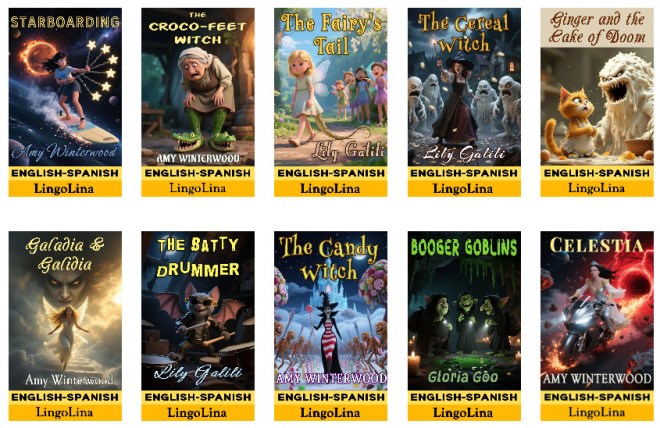
LingoLina’s bilingual books feature exciting stories told in English first and then in Spanish, sentence by sentence. Your child always knows what is happening so they never feel lost, and they naturally pick up new Spanish words as they follow along.
These books make perfect props for your in-house language classroom because they are enjoyable, easy to follow, and genuinely fun for kids to read out loud to you or to their class of plushies and dolls.
You can hand your child a book and say, “Teacher, can you read today’s story to the class?”
After they read a chapter aloud, they can point to a Spanish sentence and quiz you with great seriousness: “What does this line mean, student?”
They can assign a word search puzzle to you or to a plushie as homework and proudly “help” when you get stuck.
They can choose random Spanish words from the page and ask you what they mean in English.
Or you can sit side by side while they read, and afterward they can ask you to spot a Spanish word they just used in the story, watching happily while you search for it like a nervous little student.
With every lesson they “teach”, their Spanish grows stronger, richer, and more confident. And the two of you get to enjoy the bilingual stories together in a way that feels like play instead of study—exactly how language learning should be.
Check out our collection of exciting, funny, and magical bilingual stories in Spanish and English for kids.

 LingoLina