
Discover how to turn nightly bedtime stories in Spanish (or bilingual stories) into natural language learning without effort, stress, or boring lessons.
Most parents read bedtime stories to relax their kids. A warm blanket, a familiar voice, and a world of imagination. It’s the classic nighttime routine. But what if those cozy tales could secretly teach your child Spanish, without a single quiz, worksheet, or lesson plan?
Turns out, they absolutely can.
And bedtime is the perfect moment to sneak Spanish into your child’s brain, softly and powerfully.
In this guide, you’ll learn how reading bilingual English-Spanish kids stories at night transforms into real language absorption using proven neuroscience, emotional connection, and zero stress.
Does reading Spanish at bedtime really help kids learn the language?
Here’s a little secret most people don’t know: bedtime is neurologically primed for learning.
Right before your child falls asleep, their brain begins consolidating memories from the day. Anything emotionally resonant or repeated is more likely to stick. That means stories, especially ones they love, get a VIP ticket into long-term memory.
Now add a Spanish language translation to that story? You’ve just set up the perfect Spanish language learning loop.
The trick is consistency, comfort, and connection.
Reading the same bilingual bedtime story across a few nights creates natural spaced repetition which is the brain’s favorite way to memorize without trying. Words get heard again and again, but always in context, always with feeling and visuals, always while the brain is relaxed. This is passive learning at its finest.
In short: your child’s brain is naturally built to learn languages and memorize words at bedtime. You just need a fun, engaging bilingual story your kid enjoys.
The Brain Science Behind How Kids Learn Spanish from Reading Bilingual Stories
This is where it gets fascinating.
When your child hears a sentence first in English, and then the same sentence in Spanish, their brain lights up in all the right places. It’s a process called Synaptic Language Linking. Here’s how it works: Familiar meaning activates memory and understanding. Then, when the Spanish version is read right after, the brain automatically attaches the new sound to the old meaning.
No translating. No effort. Just natural connection.
Scientifically speaking:
The Wernicke’s area (language comprehension) and the temporal lobe (long-term meaning storage) light up when the English line is read.
As the Spanish line follows, those same areas stay active, now receiving the new language input and wiring the association in real time.
Add imagination (from the story), emotion (from the characters’ adventures), and rhythm (from the reading). Now the amygdala and auditory cortex jump in too.
It’s like giving your child’s brain a rich, bilingual feast where new Spanish words are understood, visualized, experienced, felt, learned, and memorized naturally.
No grammar charts necessary.
How do bilingual bedtime stories help kids learn Spanish naturally?
LingoLina’s stories follow a very specific formula: one sentence in English, followed immediately by the Spanish version. This is the NeuroFluent™ Immersion Method, and it’s designed to keep the brain fully engaged, comprehension clear, and confusion-free.
That line-by-line pairing creates a smooth, relaxing rhythm.
Kids always understand what’s happening because they first hear it in English.
And while they’re just listening, their brains are absorbing the patterns and words they hear in Spanish. This activates the basal ganglia, the part of the brain responsible for implicit (natural, unconscious) learning, like riding a bike or recognizing a melody. That’s how they start to “get” Spanish without even trying.
The method grows with them. A six-year-old might listen for fun. An eight-year-old starts recognizing written words. A ten-year-old begins reading the Spanish lines themselves.
Are bilingual bedtime stories better than apps for teaching kids Spanish?
Yes.
Apps and flashcards rely heavily on short-term memory. They drill isolated words, not real meaning. Sure, they might memorize some words. But they’ll forget them just as fast. Just like you and me forgot at least 70% (if not more) of all the millions of facts we learned in school as kids.
Reading bilingual Spanish-English stories is different.
When a child is wrapped up in a tale about a brave cat chasing an evil cake across the galaxy, a princess stranded on a wild alien planet, or goblins staging a tissue heist, they’re not memorizing—they’re feeling. They’re experiencing the story and the Spanish words. And what the brain feels, it remembers.
In fact, a Harvard study found that information presented as a story is remembered 22 times more than facts alone. That’s because stories activate multiple parts of the brain: logic, language, emotion, and imagination.
Flashcards can’t do that. But stories can. And bedtime stories do it best.
What’s a good Spanish bedtime story for beginners?

Pick a story with an engaging plot, a theme your kid likes, and short, easy-to-follow sentences written in simple Spanish.
For younger kids, the sentences should be short and simple. For slightly older kids, the sentneces can be slightly longer with some more complex words.
For instance, StarBoarding is a space fairy tale for ages 9-12 about a wild girl named Shanuka who races through the galaxy on glowing, enslaved stars. It’s beautiful, emotional, and perfect for bedtime. And yes, it secretly builds vocabulary around family, fantasy, rebellion, emotions, colors, body parts, actions (jump, crouch, crawl etc.), morals (honesty, lies, guilt, punishments, justice, liberty), and family.
The English-Spanish pairings make the story easy to follow even if your child doesn’t know any Spanish yet. The sentence structure is natural, the tone is exciting, and the pacing is designed for comprehension.
Best of all, your child will never feel like they’re in a Spanish lesson. They’ll just be dying to know what Shanuka does next.
How can funny Spanish stories help my child learn Spanish faster?
Yes, the funnier, the better. When kids laugh, their brain releases dopamine, a feel-good chemical that strengthens learning pathways.
That’s why funny Spanish stories work so well, especially before bedtime.
Ginger and the Cake of Doom
A brave, fiercely loyal cat, a possessed cake, a kidnapped granny, and a flaming frosting trail across the galaxy.
This whimsical adventure teaches food words, verbs, dramatic expressions, colors, survival phrases, bravery, loyalty, and home-related vocabulary.
Your child will pick up phrases like “¡Sálvame!” without blinking.
Booger Goblins
Gross. Hilarious. Funny. When Booger Goblins hatch a daring plan to steal 300 hankies from the mayor’s vault things don’t go as planned.
One sticky trail of slime gives them away and leads to chaos, kung fu fights, and a national hankie crisis that just might turn these slimy outcasts into the #1 most wanted criminals or unlikely heroes.
Kids will absorb Spanish vocabulary around emotions, action (running, jumping, falling, kicking etc.), colors, cities, actions, friends, morality, forgiveness, and redemption.
The Fairy’s Tail
Liz is a sweet young fairy born with a lizard’s tail thanks to a greedy nanny and a magical mishap. Mocked by her peers and desperate to fit in, Liz sets off on a daring quest to get rid of her cursed tail.
A sparkling, heartwarming tale of friendship, courage, loyalty, and the journey to finding your true place in the world. Kids will learn words about animals, the forest, family, loyalty, bravery, love, kitchen words, emotions, and colors.
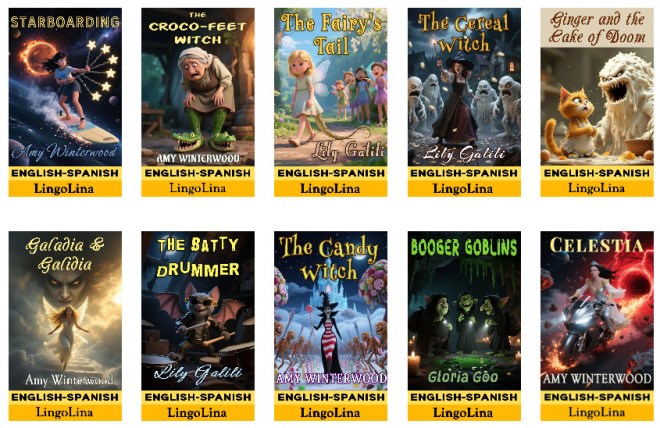
Check out our growing library of bilingual bedtime stories for kids here.
What’s the right age to start teaching Spanish through bilingual stories?
Any age where your child enjoys storytime.
A toddler who loves being read to will soak up rhythm and structure. A six-year-old who asks questions will start linking phrases across languages. A ten-year-old with a big imagination will start spotting patterns, recognizing words, and even skipping ahead to read the Spanish line first.
Age 3–6 is all about fun, rhythm, comprehension, and repetition.
Age 7–10 is perfect for vocabulary growth and improved fluency in speech.
Age 11–13 is where confidence blooms and vocabulary expands to more complex phrases, words, and grammar.
The secret is finding many stories they love, so they keep reading, are consistently exposed to Spanish, and see common words again and again in different contexts.
How do I read Spanish stories if I don’t speak Spanish?
This part surprises a lot of parents: you don’t need to speak Spanish to teach your kid Spanish through stories.
Each sentence in bilingual stories like from LingoLina is already translated.
You simply read the English line, then the Spanish one right after. You don’t have to teach. You don’t have to explain. You just read. If you stumble through a pronunciation? That’s okay. Your child is learning that languages are fun, not scary. Progress, exposure, and comprehension matter more than perfection.
You can also let the audiobook do the work, so your child hears perfect pronunciation without you needing to do anything at all.
Your job is to make it cozy. Read together, listen together, guess the Spanish words together, laugh at silly lines together. The more joy and comfort your child feels during this bilingual storytime ritual, the faster the Spanish language sticks.
Can bedtime stories alone really teach my child Spanish?
Yes, but not overnight.
This is slow, stress-free, natural immersion. The kind that actually works long-term. The kind that creates bilingual kids who don’t even remember how they learned Spanish, just that it was always there.
Your child won’t memorize a giant vocabulary list in a week. But after a few weeks of nightly stories, they’ll start recognizing and pointing out words. After a few months, they’ll be speaking phrases. Give it a year, and they’ll understand spoken Spanish better than most adults who’ve taken classes.
Fluency will come naturally after enough exposure to Spanish.
And it will never feel like stressful Spanish lessons.
What’s the easiest way to teach my child Spanish at night?
Don’t think of it as teaching. Think of it as bedtime stories, just upgraded.
Here’s what to do:
- Pick a story they love. Laughter, adventure, fantasy, whatever keeps them engaged.
- Read the English sentence. Then read the Spanish one right after.
- Let the story carry them. No pressure. No correction. No vocab tests.
- Re-read favorites. Repetition is powerful.
- Listen to the audiobook version if you’re tired or unsure about pronunciation.
- Snuggle up, say buenas noches, and let their brain store the new words in their long-term memory and build the neural language pathways they need to learn Spanish.
Conclusion: Let Bilingual Stories Teach Your Kid Spanish
If you’ve ever wished your child could learn Spanish without fighting you, without dreading lessons, without begging to quit, this might be the easiest way you’ve discovered.
Replace bedtime English stories with a magical bilingual story. Night after night, line by line, your child will start to understand, absorb, and eventually use the language.
Not because you made them. But because you made it fun.
So tonight, skip the apps. Ditch the grammar books.
Grab a bilingual bedtime story instead.
Your child won’t even notice they’re learning.
But their brain will. And it’ll thank you for it later.

 LingoLina