
If you’re teaching your child Spanish at home, you might wonder:
Is it working? Are they really learning?
When you skip flashcards, grammar drills, and stressful testing in favor of bilingual stories, tracking progress might feel less obvious. But make no mistake: your child is learning, and the signs are easy to spot once you know what to look for.
In this guide, we’ll walk through how to measure your child’s Spanish learning progress using bilingual stories.
Whether you’re using bedtime tales, storytime rituals, or audio stories on the go, this article will give you a clear month-by-month roadmap to see results, without pressure or tests.
We’ll also cover the science behind story-based learning, common parent questions, and why this method is one of the easiest, most brain-friendly ways to teach kids Spanish naturally.
Month 1: Spanish Storytime Spot-the-Word Game
At this stage, your child is just starting out. They might not speak a word of Spanish yet, and that’s perfectly fine. Your goal is exposure, repetition, and fun.
Choose a bilingual story where each sentence appears first in English, then in Spanish. After reading, casually ask your child what one common Spanish word meant. Choose something that repeated often in the story: “gato” if it featured a cat, or “bruja” if there was a witch.
Then re-read the story together and turn it into a game: Can they point to the Spanish word “bruja” when they hear “witch” in English? Can they find the word “bruja” each time it is read in Spanish?
This is not a quiz. It’s a treasure hunt. If they can do it, learning happened.
Month 2: Using Spanish Story Words in Real Life
Now that your child has heard a few stories, it’s time to gently bring Spanish into daily life.
If the last book you read was about food, ask during lunch: “Do you want pan con queso or pan con jamón today?”
You can also play a simple translation guessing game. Say a sentence from the story in English and offer three Spanish versions. Let your child guess the right one. Even if they’re unsure, they’ll usually get it right thanks to repetition. That’s how we know comprehension is growing.
Month 3: Spanish Word Puzzles and Story-Based Recall
Your child has now heard dozens of Spanish words across several stories. This is a great time to test word recognition with puzzles or drawing games.
Print out a word search or crossword using common words from the last story. Or write a few Spanish words and ask your child to match them to pictures.
You can also play “Draw the Story.” After reading, ask your child to draw a scene and label it using any Spanish words they remember. The number of words doesn’t matter. The fact that they recall any is proof of progress.
Month 4: Reading a Familiar Story Entirely in Spanish
Pick a story your child knows well, something you read last week or a favorite tale. This time, read it entirely in Spanish.
Ask questions afterward:
- Can they follow what’s happening?
- Can they name five objects or characters in Spanish?
- Can they draw a scene and label parts in Spanish?
Understanding a full Spanish story (because they already know it in English) is a powerful sign that bilingual exposure is working.
Month 5: First New Story in Full Spanish (Pure Immersion)
Now you’ll try reading a new short story entirely in Spanish. Keep it simple. Afterward, ask your child:
- What was it about?
- What happened first, next, last?
- Can they retell it in their own words?
If they understand most of the plot, that’s amazing progress. If not yet, that’s totally fine. Go back to bilingual stories for a while longer. Their brain is still wiring those new language pathways. Just like a seed needs watering, Spanish comprehension grows with exposure.
Does Story Learning Really Work for Kids? (Yes, and I’ve Lived It)
I spoke three languages by the time I was four. My mom talked to me in English, and I picked up German through picture books and by playing with other kids.
But here’s the thing: when I was born, my mom didn’t speak a word of German. She learned it just by reading me children’s books. And I learned right alongside her—without flashcards, without rules, just stories.
When I was twelve, I enrolled in a German high school. That’s when I really saw the drastic difference in how fast kids can become fluent with the story-based method. That year, I discovered something amazing.
In French class, our teacher drilled us with endless, tedious, old-school grammar and vocabulary lessons. Rules. Conjugations. Quizzes. Lists. Charts. Relentlessly fixing our pronunciation of each word. Endless stressful pop quizzes and read-out-loud sessions in front of a sniggering class and a scowling, scolding teacher. All year.
By the end? We could say maybe five basic sentences. We could ask if someone had a dog or a cat. We could say our name and greet someone politely. That was about it.
We sounded okay, but we couldn’t use the language. We couldn’t follow conversations or express a single original thought.
But in English class, the teacher did something wild: he gave us stories.
Fun ones, with paired vocabulary and translations.
By the end of that year, all of my classmates (German students who had never spoken English before) were chatting and even writing their own stories in fluent English. Long, imaginative stories. My mom was stunned. English stopped being my “secret” language with her because suddenly, everyone understood it.
Later, when I started learning Spanish at 13, my mom took me down the old-school route again. Doing what is “right” and what everyone says language learning should be like. Big grammar books. A massive dictionary. Vocabulary drills.
When I got sick of struggling alone through the grammar book, I used to read grammar rules to my mom while she cooked, just to annoy her.
She hated it. I hated it.
Eventually, my tactic worked. She couldn’t stand it anymore and gave up, throwing all the books away.
Years later, I picked Spanish back up using Netflix with subtitles. That helped a little, but it was exhausting. I missed most of the story trying to keep up with the captions. And my eyes hurt afterward.
The one thing that finally worked?
Creating bilingual content.
I used browser extensions to translate articles and stories, sentence by sentence, and listened to the audio, even though it sounded like a robot with a cold. But the format made sense. I finally understood what I was reading and hearing. And it was far more enjoyable than any grammar lesson.
Bilingual content is what finally taught me Spanish.
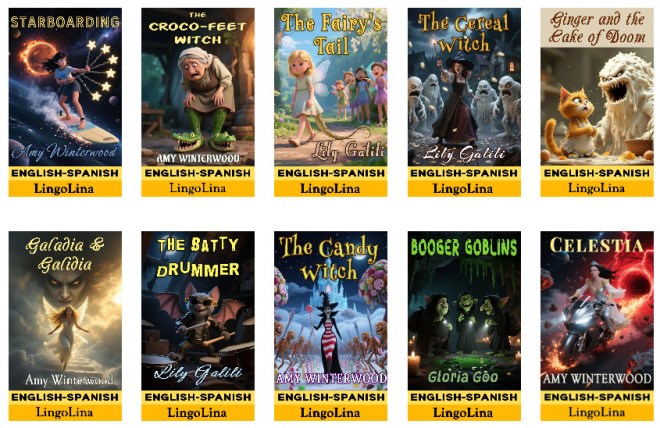
That’s what made me build LingoLina.
I wanted to create the kind of Spanish stories I wish had existed back when I was learning. High-quality translations, engaging audio, and content I would have loved to read. Bilingual content that made comprehension easy, stories that were actually fun, and formats that didn’t require flipping open a dictionary at each sentence or constantly guessing.
It’s the same way my mom learned German.
The same way my 27 classmates became fluent in English.
Because when the story pulls you in, the language comes with it.
The Science Behind Story Learning
Children learn best through meaning and emotion, not memorization. A Harvard study found people remember information 22 times better when it’s delivered through a story instead of dry facts. Why? Because story-based learning activates more parts of the brain at once.
When kids read or listen to a bilingual story, here’s what happens:
- The temporal lobe and Wernicke’s area interpret familiar words.
- The visual cortex imagines the scene.
- The amygdala stores emotional memories.
- The brain builds a mental map, linking the Spanish sound to a known idea.
This is called Synaptic Language Linking. Each English sentence lights up the brain with meaning, and the matching Spanish line creates a bridge to new words. Over time, the brain begins to recognize these patterns without effort.
Add to this the power of dual coding (combining sound and image) and spaced repetition (seeing and hearing words repeatedly), and you’ve got the perfect formula for language absorption.
Unlike grammar drills, story learning taps into long-term memory and keeps the affective filter low (the mental learning barrier that arises from stress), meaning kids stay relaxed, curious, and emotionally engaged. That’s the sweet spot for learning.
Common Questions Parents Ask About Bilingual Stories for Kids
Can kids really learn Spanish from stories alone? Yes. Stories provide repeated, meaningful context. This is how we learned our first language: not from word lists, but from hearing language inside moments, images, and emotion.
What if my child doesn’t speak much yet? That’s normal. Understanding always comes before speaking. Your child might go through a “silent period” where they’re absorbing tons of language before producing it.
How long does it take to see results? Within the first month, most parents notice word recognition. By month 3 or 4, kids often start using a few words or phrases. Daily exposure matters more than speed.
Is repetition really okay? What if my kid wants to hear the same story 10 times? That’s fantastic. Repetition is how the brain builds fluency. Each reread strengthens comprehension and reinforces memory.
What if I don’t speak Spanish? Can I still use bilingual stories? Absolutely. Bilingual sentence-by-sentence stories like LingoLina’s are designed for non-Spanish-speaking parents. You’ll understand every line, and likely learn alongside your child!
Is it better to use a separate Spanish and English book or one bilingual version? Bilingual paired-sentence books are more effective for beginners and intermediates. When kids hear the English sentence first, they instantly understand what the Spanish means. This keeps frustration low and learning high.
Should I correct pronunciation or mistakes? No need. Let your child enjoy the story. If you model pronunciation gently by reading aloud or listening together, they’ll pick it up naturally.
How many stories should we read before trying an all-Spanish book? It varies, but usually after 4–5 months of bilingual exposure, your child will understand enough to try a familiar story in Spanish. Then a new one.
Can this work with audiobooks too? Yes! Hearing each line in English then Spanish while reading along reinforces comprehension, pronunciation, and memory.
What if my child forgets words quickly? That’s normal with isolated vocabulary. But in stories, words return in new scenes and new contexts. This natural spacing helps memory stick.
Your Spanish Progress Tracker Through Stories
Think of this as your invisible curriculum. No worksheets, no grades—just curiosity, exposure, and connection.
- Month 1: Recognize one common Spanish word per story
- Month 2: Guess meanings in context; respond to basic Spanish in daily life
- Month 3: Complete puzzles or drawings using remembered Spanish words
- Month 4: Understand a familiar story entirely in Spanish
- Month 5: Follow a simple new Spanish-only story with basic comprehension
If your child can do even half of these things after a few months, you’re doing great.
So the next time you wonder if it’s “working,” look for those quiet milestones: A smile of recognition when they hear “bruja.” A confident answer when you ask what “pan con queso” means. A drawing labeled with the word “gato.”
That’s progress. That’s fluency in the making.
And the best part?
They won’t even realize they’re studying.
Because with bilingual stories, they’re just reading. And learning Spanish the way nature intended.

 LingoLina