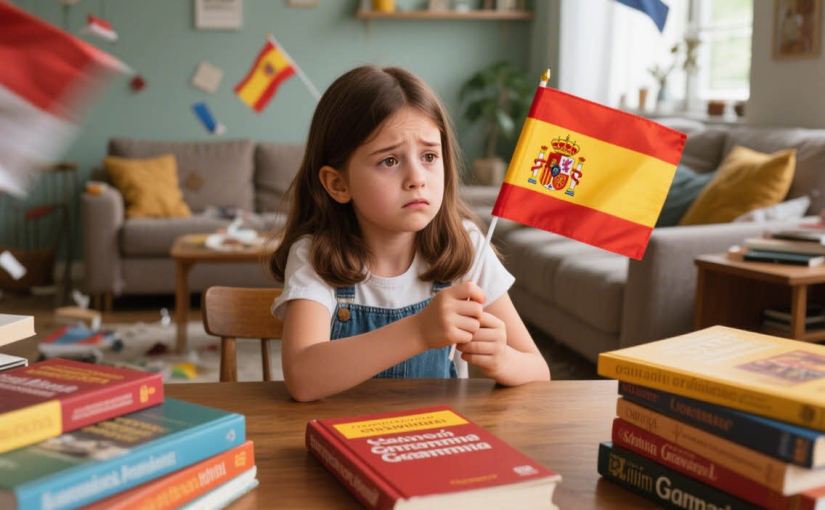
If you’ve ever spent a whole week practicing Spanish with your 7-year-old, only to hear them blank out or shrug when you ask, “What does gato mean again?” you’re not alone.
It can feel like you’re pouring water into a bucket with a hole in the bottom. They seem to understand in the moment, but by the next day? Gone. Poof. Vanished.
So, is something wrong? Are they too distracted? Too young? Not trying hard enough?
Actually, it’s none of those things. There’s a much better, science-backed explanation and an even better fix. And it starts with a part of your child’s brain that’s still under construction at age 7.
What’s Going On in a 7-Year-Old Brain?
Here’s the thing: a 7-year-old’s brain isn’t a mini adult brain. It’s more like a city where the main roads have just been paved, but a lot of the highway connections are still being built.
One of the key things still happening in that busy brain is called myelination.
Think of myelin as the insulation on electrical wires.
When your brain cells (neurons) send messages to each other, they do it through little wires called axons. Myelin wraps around those wires and makes the signals travel faster, smoother, and more reliably.
It’s the difference between an old country road and a fiber-optic superhighway.
In language learning, this matters a lot. Because the faster those signals can move from your child’s ears (what they hear), to their understanding (what it means), to their mouth (what they say), the easier and more fluent their Spanish becomes.
Now here’s where it gets interesting:
The parts of the brain that hear and understand sound (auditory cortex) are already pretty well-developed by age 7.
BUT the parts that connect meaning and speech, like Broca’s area, Wernicke’s area, and especially the arcuate fasciculus (the “cable” connecting them) are still myelinating.
Still building. Still under construction.
Still being ‘upgraded’ to a faster, more reliable cable, you might say.
So if your child seems to understand Spanish but can’t quite speak it, or remembers it during a lesson or story but forgets it later, it’s not a failure. It’s their brain doing exactly what it’s supposed to do.
And all it means is that the way we teach them has to match that timeline.
Why Traditional Language Learning Methods Backfire at Age Seven
Here are a few common teaching habits that accidentally work against your child’s wiring right now:
1. Word lists without context or stories. Isolated words are harder for a 7-year-old’s brain to hold onto. There’s no story, no emotion, no context. It’s like handing them loose puzzle pieces with no picture to look at. Dry words with no feeling, emotion, color, or meaning attached.
2. Constant correction. When you stop every time they get a word wrong, or mispronounce something, it feels like a pop quiz. Their brain switches into stress mode, which actually blocks memory formation by raising the affective filter. They learn less the harder they try to impress you and the more they fear making mistakes.
3. Pure immersion too early. With movies or audiobooks, if they don’t understand Spanish and the Spanish sentence doesn’t make sense right away, their brain freezes trying to catch up. And while they’re trying to process the first one… it’s already on to the fourth! That effort can feel overwhelming. They don’t learn to swim; they just sink and end up hating the water.
How to Easily Teach Your 7-Year-Old Spanish
Here’s the golden rule of teaching kids Spanish at age 7:
Make meaning instant.
When comprehension is easy and stress-free, your child’s brain relaxes. Relaxed brains remember. They build faster connections. And because the input is complete and enjoyable, output eventually becomes smooth and automatic.
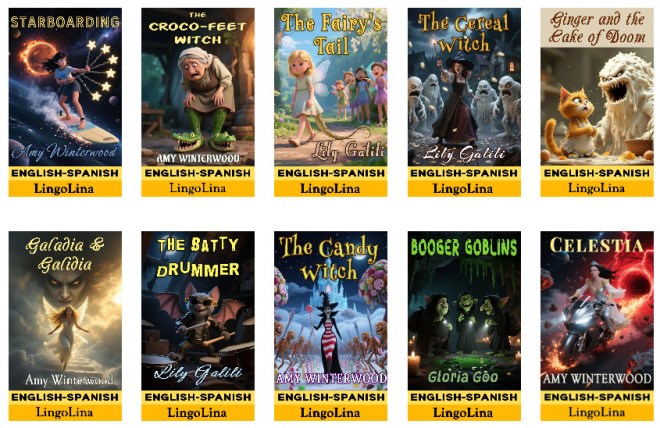
That’s the power of bilingual stories like the ones from LingoLina™. Each sentence appears first in English, then in Spanish. Your child always knows what’s happening. Their brain connects meaning and sound naturally, without guessing, struggles, stress, or overwhelm. And because they first understand what is going on in English and then read or hear the same thing in Spanish, they learn without even trying.
This trains the wiring in the right order.
Over time, they absorb naturally more and more vocabulary, sentence structure, and grammar without even trying. Re-reading a favorite story, or reading the same words again and again across multiple stories is what linguistic scientists call Spaced Repetition Sequencing.
Their brain’s wires grow stronger, existing language pathways get reinforced, new ones get built and strengthened.
After some months, they understand the Spanish they read. After some more months, they begin speaking it.
In summary: Prioritize comprehension first, speaking second (it speeds both).
Why Bilingual Stories (in Spanish & English) Beat Vocabulary Drills at Age 7 for Language Acquisition
Think about the last time you learned something new and remembered it. Did it stick better when you saw it on a flashcard, or when someone told you a story, when you read an article, watched a weird YouTube science video, or saw a touching movie?
How much do any of us remember from all the lessons we memorized diligently in school before spitting it out in exams? Can you recite all the history books you’ve read or the answers you gave on your 4th-grade science exam?
The problem with memorized vocabulary lists is that it gets written in the short-term working memory. Without a strong emotional or visual anchor, or with too many words held in the short-term memory, words are easily wiped from the short-term memory and don’t go into the long-term memory.
Stories, however, activate more areas of the brain: images, emotions, logic, and prediction. It’s not just hearing a word—it’s living it. And that creates a stronger memory that writes into the long-term memory instead of the short-term working memory.
It’s the difference between borrowing a bunch of books and piling them on a table for a few hours or buying them and storing them in your library for good. The first ones were only there temporarily and then are gone. The latter are there forever and can be referred to when needed in the future, just like words from the long-term memory can be recalled at will.
Scientists found that our memory (Hippocampal‑cortical networks) doesn’t distinguish between a real experience and a vividly imagined one when it is imagined vividly (Dijkstra et al., 2025). If imagined vividly, it gets stored as a memory, which embeds the Spanish deeper into your child’s brain.
For instance, in an MRI study, scientists from the Washington University, found that when people read parts of the story that described movement, space, or sensations, the corresponding brain areas (visual cortex, motor cortex) lit up, even though they weren’t actually moving or seeing it themselves!
This shows that reading a story activates similar brain areas as “living” it. For a child learning Spanish through a story, it means the story is helping embed Spanish in brain networks that connect meaning, sensation, and action.
If your child imagines the green goblin running after a princess on a white horse, all those new words in Spanish “verde”, “corriendo”, “blanco”, “caballo” (“green,” “running,” “white,” “horse”) are connected to an imagined experience and get written deeper into the long-term memory.
Meanwhile, Harvard scientists discovered that the same brain regions (hippocampus and related networks) are both activated when remembering a real memory of an event or imagining something new. That means, when your kid vividly imagines a story, while hearing it in Spanish, it is written into their memory in a powerful way through the medium of imagination.
And lastly, a study published in ScienceDirect found that multiple parts of the brain and memory sync harmoniously together when a person is engrossed in a story. That means the more your kid feels the story, the more vivid the descriptions are and the more engaging it is, the more their brain networks will strengthen. That helps memory, language connections, and fluency.
At age seven, kids learn best when learning feels like play. And stories are the ultimate immersive experience that feels fun, activates emotions and multiple parts of their brain, and writes the new Spanish words they hear and read deeper into their memory.
How to Help a 7-Year-Old Remember Spanish Faster (And Easier)
You can help your child remember Spanish faster. You just have to align with their brain’s wiring plan.
1. Short daily “precision reps”
Read or listen for 10–15 minutes to a bilingual story at bedtime. Then, revisit a short part from that same story the next morning. You’re repeating, yes, but not with flashcards or pressure. It’s gentle, joyful reinforcement. Like fortifying the same path in the brain again and again to strengthen it.
2. Same frame, new scene
If your child learns a phrase like “I want…” in one story, let them encounter it in a different story the next day. New character, new setting, same grammar. That’s how you build speed: by paving and re-paving the same neural highway until it’s smooth.
3. Echo lines, then lead
Let them echo a Spanish line after you. Once they enjoy that, pause before the last word and let them fill it in. That tiny leap is the start of speaking fluently.
4. Listening and reading together
Pair a story’s text and audio. They’re seeing the word and hearing it. That strengthens visual, auditory, and meaning links all at once. It improves pronunciation, listening comprehension, speaking, and reading skills.
5. Let retrieval warm up
If they forget a word, no big deal. You can whisper it to them, or say, “Let’s hear it again in the story.” That safe feeling is what lets new connections grow.
How to Help a 7-Year-Old Speak Spanish Sooner (Without Pressure)
Speaking will come. It always does after comprehension. Just like babies first absorb words, understand, then speak.
But we can make the path to speech smoother with a few fun, stress-free tools.
Call-and-response mini-games
Read a Spanish sentence from the story or chapter you just read. Ask them what it means in English.
Say the English sentence from a story you just read. Let your child respond with the Spanish version. If they hesitate, say it with them.
Read-together trick
They read the English line. You read the Spanish. It feels like teamwork. You each have a job. Eventually, you can gently swap roles. This builds confidence and fluency without pressure.
Role-play favorite scenes
Act out a funny bit from a story using toys, costumes, or paper cutouts. Don’t correct them mid-sentence. Let them experiment and enjoy it. You’re not testing, you’re playing.
Activities
Draw a scene from the story. Fill in a coloring-in sheet. Find hidden Spanish words in a word scrabble game.
Whisper first
Have them whisper a line with you. Then say it normally. This builds the speech muscle quietly first, like a warm-up before a performance.
Micro-prompts in playtime
Sprinkle story phrases into daily life: at breakfast, during drawing, while walking. Let them echo without calling it “practice.”
Weekly Spanish Learning Routine for 7-Year-Olds That Works
Mon–Thu: Read + listen to one paired story before bed (10–15 minutes). Don’t pause. Just enjoy it.
Next morning: Play back 2–3 minutes of a favorite part. Echo one fun line.
Friday: Read their favorite story from the week again. Let them finish some lines if they want to.
Saturday: Watch a familiar movie, but in Spanish. If needed, use English subtitles.
Sunday: Start a new story that uses one or two familiar sentence frames (“I want…” / “There is…” / “He can…”).
Choosing the Right Stories
Pick what they love. Fairies. Goblins. Ghosts. Space battles. Funny stories. Witches. Whatever makes them want to keep turning pages.
Short lines, clear pairing. Each English sentence directly followed by its Spanish twin. That keeps the comprehension smooth.
Built-in repetition. Stories with refrains or catchphrases naturally strengthen memory. Bonus if they make your kid laugh.
What to Avoid Doing When Teaching a 7YO Spanish
Correcting mid-sentence. Let the story flow. Let the memory form. There’s time for refinement later.
Drilling vocabulary out of context. If a word came from a fun story, it will return naturally. If it came from a flashcard… not so much.
Trying ten things once. Better to do one thing ten times with joy than ten things once with stress.
Quick Recap: Why Bilingual Stories Work Best At Age 7 for Language Learning
- Myelin makes brain signals faster and more reliable.
- At 7, their “language cable” (arcuate fasciculus) is still maturing.
- Comprehension builds first. Speaking catches up.
- Stories activate more of the brain and make memory stronger.
- Repetition within stories grows fluency without pressure.
Try a Fun Bilingual Story for Kids Tonight
Start with one bilingual story your child will love. Read and listen together before bed. Re-read their favorite part in the morning. Add a little echo game or shared reading line. Repeat the story across a few nights. Then try another.
You’re building their brain’s language highways, one bedtime story at a time.
And if your 7-year-old forgets a word today? That’s okay. That’s just a brain that hasn’t finished laying the full cable yet. But it will.
Check out our growing library of exciting, immersive bilingual stories for ages 6-12.
Common Questions Partners Ask
Why does my 7-year-old forget Spanish so quickly?
At age 7, brain pathways for language are still developing. If new Spanish words aren’t tied to meaning or emotion, they don’t stick long-term.
What’s the best way to teach a 7-year-old Spanish?
Use bilingual stories where each sentence is first in English, then in Spanish. This builds natural comprehension and memory without stress.
How can I help my 7YO child remember Spanish better?
Repeat meaningful, enjoyable content, like bedtime stories, with short, daily routines. The brain remembers what it enjoys and understands.
Should I correct my child’s Spanish pronunciation right away?
Not during stories. Let them build fluency and comfort first. Gentle correction can come later once confidence is high.
Why do stories help with Spanish memory?
Stories activate more brain areas than drills, including emotion, imagination, and memory. They make Spanish feel real and memorable.
Can kids learn Spanish by just watching shows?
It depends on what type of show and their level. For beginners, pure Spanish immersion can be overwhelming and backire. Most 7-year-olds need clear meaning first. Try bilingual stories or familiar movies dubbed in English, simple comics or animations with English subtitles, then move to pure Spanish immersion later.
How long does it take a child to start speaking Spanish?
It varies, but many begin using short phrases naturally after 4–8 weeks of consistent, story-based input, even without formal lessons.
Is my 7-year-old too old to learn Spanish and become fluent?
Not at all. Ages 6–10 are a great window for language learning. Their brains are flexible, but they still need the right kind of input.
What if my kid understands Spanish but won’t speak it?
That’s normal. The brain’s comprehension systems develop first. With time, repeated exposure, and zero pressure, speech will follow.
References
Schacter, D. L., Addis, D. R., Hassabis, D., Martin, V. C., Spreng, R. N., & Szpunar, K. K. (2012). The future of memory: remembering, imagining, and the brain. Neuron, 76(4), 677–694. https://doi.org/10.1016/j.neuron.2012.11.001
Ohad, T., & Yeshurun, Y. (2023). Neural synchronization as a function of engagement with the narrative. NeuroImage, 278, 120215. https://doi.org/10.1016/j.neuroimage.2023.120215
Speer, N. K., Reynolds, J. R., Swallow, K. M., & Zacks, J. M. (2009). Reading stories activates neural representations of visual and motor experiences. Psychological science, 20(8), 989–999. https://doi.org/10.1111/j.1467-9280.2009.02397.x
Saplakoglu, Y. (2023, August 27). Is it real or imagined? Here’s how your brain tells the difference. Wired. https://www.wired.com/story/is-it-real-or-imagined-heres-how-your-brain-tells-the-difference/
Tran, L. (2025, October 20). How the art of storytelling alters memory formation. The Scientist. https://www.the-scientist.com/how-the-art-of-storytelling-alters-memory-formation-73619

 LingoLina