
If you’ve ever wondered whether your 7-year-old is too young to learn Spanish, too distracted, or just not showing enough interest yet, you’re not alone.
Here’s some encouraging news: age seven comes with its own special advantages for learning Spanish.
It’s a fun, flexible time in your child’s development right between the sponge-like early years and the more logical, rule-focused stage that kicks in later.
At age 7, kids are curious, imaginative, and just starting to develop stronger reading and thinking skills. It’s the perfect moment to introduce a language through playful stories and natural immersion.
You don’t need flashcards. You don’t need grammar drills. You don’t need hours of practice. And it certainly doesn’t have to feel like more homework.
What’s Happening in a 7-Year-Old’s Brain (And Why It Matters for Spanish Learning)
Around age seven, children’s brains are going through some seriously exciting changes. They’re not toddlers anymore, but they’re not mini-adults either.
Their cognitive systems are developing rapidly, but certain parts, like focus, self-control, and memory juggling, are still very much under construction.
A 7YO’s brain is literally being “rewired” and upgraded
Inside the brain, the connections between neurons (the “wires”) are being wrapped in insulation, a process called myelination. This makes signals travel faster and more reliably. Think of it as copper wires being upgraded to fiber optic; they work faster and better.
And guess which wires are getting “upgraded” at this age? Language pathways!
This means their brain is getting more efficient at linking sounds, meanings, and vocabulary together. Right now, their neural circuits for learning languages are getting an upgrade. So you want to take advantage of it.
Avoid overloading your 7-year-old’s working memory
The part of the brain that controls focus, attention-switching, and planning is called the prefrontal cortex. Imagine it as an “air-traffic control tower” which is still being built.
At seven, it’s still a work in progress.
So if you try to teach Spanish with long lessons, complex explanations, overwhelming vocabulary drills, or noisy environments, it’s like trying to land too many planes at once. Things get jammed. Cue confusion, overwhelm, boredom, and one unhappy little learner.
Interestingly enough, though, according to a study in Developmental Science, seven-year-olds can focus much like adults, as long as the amount of information they’re holding in mind stays small. Pretty amazing, right?
The catch is that working memory (the “workspace” the brain uses to process things right now, not to store them long-term) is still limited at this age.
If you cram too many words, rules, or ideas into that small workspace, it spills over, much like pouring too much water into a little bucket. The result looks like “bad attention,” but it’s really overload.
When kids seem distracted or “unmotivated,” it’s often because we’ve asked them to juggle too much at once, not because they don’t care.
Their memory works best with bite-sized pieces
Working memory is like a sticky note in your child’s mind. It can only hold so many bits of info at once.
If you throw a 25-word Spanish vocabulary list at it, the sticky note overflows and words fall off.
But if you teach your kid just a few Spanish words at a time, or let them naturally absorb words through an imaginative, visual story… boom, the sticky note holds onto the new words, and the brain files it away more easily.
A 7-year-old remembers best when they sleep after learning
One of the coolest things? Kids between 7 and 12 actually consolidate memories better than adults while they sleep. That’s because they spend more time in deep sleep, the kind that helps store information into long-term memory (Pfeiffer, 2020; Wilhelm, 2008).
So when your child hears new vocabulary or listens to a bilingual story in the evening and then heads to bed, their brain keeps working behind the scenes, locking in those new Spanish words.
What Most Parents Accidentally Do Wrong When Teaching a 7-Year-Old Spanish
Let’s start with what doesn’t work, so we can avoid it:
Huge word lists
They look impressive, but they overwhelm your child’s working memory. Without context, it’s just mental clutter.
Translation drills or grammar explanations
You might think “tiene = has” is helpful, but a 7-year-old’s brain doesn’t work like that yet. It needs stories, images, emotions. Not boring, abstract rules.
Fast audio or noisy background distractions
If the Spanish story is too fast, or there’s chatter, dishes clinking, or a TV on in the background, it becomes almost impossible for your child to focus. Because their auditory filters, what scientists call “speech-in-noise” processing, are still maturing.
One big cram session before bed
Sounds smart, but it doesn’t give time for retrieval or spaced repetition. Your child might seem to “get it” that night, but they’ll forget it by the next week.
Why Bilingual Stories Work So Well for Teaching Kids Spanish
Now, compare that with a story-driven bilingual approach.
Let’s say your child hears:
Johnny tiptoed through the jungle, his heart thumping like a drum.
Juanito caminó de puntillas por la selva, con el corazón latiendo como un tambor.
Vines tangled at his feet.
Lianas se enredaban alrededor de sus pies.
Birds shrieked in the distance.
Los pájaros chillaban a lo lejos.
Suddenly—rustle rustle—something moved behind the bushes.
De repente—crujido crujido—algo se movió detrás de los arbustos.
He froze.
Se quedó completamente quieto.
Slowly, he turned his head.
Lentamente, giró la cabeza.
Two glowing eyes stared back.
Dos ojos brillantes lo miraban fijamente.
He yelped.
Soltó un grito ahogado.
A lion! A huge one, golden and muscular, watching him from the shadows.
¡Un león! Uno enorme, dorado y musculoso, observándolo desde las sombras.
The lion opened its mouth and—
El león abrió la boca y—
“¡ROOOOAR!”
“¡ROOOOAR!”
The lion roared loudly.
El león rugió fuerte.
In that moment, kids aren’t just hearing a list of new Spanish words they have to memorize; they see a story in their mind. They picture the jungle. They hear the roar. They feel that tiny spark of fear and excitement. Emotion lights up the brain like a switchboard.
And when a new Spanish phrase is tied to a feeling, an image, and a story beat, it sticks. It’s one of the reasons story-based immersion works so well: memory, imagination, and language all fire together.
In fact, research shows that when kids hear stories that include both meaning and imagery, multiple brain areas are activated: the part for understanding words (temporal lobe) and the part for seeing things in the mind’s eye (visual cortex). That’s a powerful memory cocktail.
Bilingual stories for kids in Spanish and English make language learning feel like play, not like homework. It’s an enjoyable way to be exposed to new words.
How can a 7-year-old learn Spanish through stories?
Here’s what happens when your kid (and you) listen to a bilingual story:
Here’s what happens when your kid (and you) listen to a bilingual story:
You hear a sentence in English first—something simple like, “The lion roared loudly.”
Then immediately after: “El león rugió fuerte.”
You don’t have to explain it. You don’t have to pause and quiz them. The brain does the work for you.
Because the meaning is already clear in English, the Spanish sentence slides right into place. Over time, your child starts to recognize the Spanish version. They remember and recognize more and more words. Then they understand it without thinking.
No memorizing flashcards. No grammar drills. Just gentle, joyful exposure.
And the more stories you read together, the more of these little connections your child’s brain starts to build, word by word, phrase by phrase, without pressure or stress.
When stories are bilingual, first in your child’s native language, then in the target language, the meaning is already clear when the new words arrive. Neuroscience calls this associative learning. The brain grabs onto the known (“the lion roared”) and binds it tightly to the new (“el león rugió”).
That’s what scientists refer to as Synaptic Language Linking, the brain’s way of wiring new sounds to old meanings. And the more senses involved, the more powerful the memory becomes. If your child hears the story, sees the scene in their mind, and feels emotion, that word sticks.
And here’s what’s really exciting: the brain doesn’t even need full focus for this to work. When a child listens passively, while drawing or playing, for example, their auditory system is still logging those patterns, thanks to the basal ganglia. This system is the same one babies use to acquire their first language. They’re not memorizing, they’re absorbing.
Stories activate both sides of the brain:
- Left side for logic, patterns, and language
- Right side for emotion, imagery, and imagination
And when those parts fire together, they wire together. The result? Vocabulary and sentence structures that aren’t just remembered—they’re lived.
That’s why bilingual storytelling, especially in a paired-sentence format like the NeuroFluent™ method LingoLina™ uses, is so powerful.
It gives your child everything the brain craves to learn a language: meaning, repetition, imagery, emotion, and rhythm.
No stress. No drills. Just adventure. And funny fantasy characters.
The Best Methods to Teach Spanish to Your 7-Year-Old
Start with short, bilingual sentences
Choose content your kid enjoys and that’s at the right level for them.
Always start in English so the meaning is crystal clear, then repeat in Spanish.
“The cat climbs the tree.”
“El gato trepa al árbol.”
This immediately helps their brain connect known meaning to the new sounds, without confusion or effort. And it invites imagery, your child might picture a mischievous little cat scaling a tree. Perfect.
Keep sessions short, just 10 to 20 minutes
This respects their working memory, and it fits beautifully into your day. It could be before bed, after school, or even in the car.
Ask them questions
After the story, ask something simple: “How did James save the princess?”.
That act of retrieving the answer strengthens the memory more than rereading it would. It’s the difference between watching a recipe video and actually making the dish.
Repeat stories every few weeks
This is called spaced repetition. Come back to the same favorite story a week later. The brain loves this, it’s like watering a plant. Each revisit makes the roots stronger.
Use clean audio in a quiet setting
Avoid fast-paced or background-noise-filled audio. Seven-year-olds need clear input to properly absorb new sounds. Play it on your phone in a calm room, ideally with just you and your child listening together. Or read it yourself in a clear, unrushed voice. Avoid a monotone or bored tone. Try to make it sound exciting and fun.
Pair words with pictures, emotions, and movement
Stories that have characters, adventure, surprise, or even a little silliness, activate emotional memory. And if your child draws a scene, acts it out, or repeats a phrase with flair? Even better. Movement and emotion both deepen the memory.
Avoid grammar talk at the beginning
They don’t need to know why “gato” comes before “trepa.” They’ll pick up patterns naturally from full sentences. Grammar can wait until their executive function (the brain’s rule-keeper) is more mature or later once they have a strong fundamental understanding of the Spanish they hear.
Don’t pressure them to repeat Spanish before they’re ready
Don’t force it. After a few sessions, they might just blurt out a Spanish word while playing. Or they might act out a story scene and repeat a phrase. That’s learning. It doesn’t need to be perfect, it just needs to feel fun and safe.
But maybe you’re thinking: Okay, stories sound great, but I already bought those colorful Spanish flashcards… or I have that language app… or my child actually enjoys worksheets and vocab games. And that’s perfectly fine!
The point isn’t to throw everything else out, it’s to make sure the tools you’re using are shaped in a way that actually fits your child’s brain.
Want to use flashcards or apps? Here’s how to do it right for a 7-year-old brain.
Flashcards, apps, and even vocabulary drills can work at this age—but only when used in short, focused, meaningful ways. Here’s what to keep in mind:
1. Use images, not just translations
Instead of pairing the word “perro” with “dog,” pair it with a picture of a dog. Even better? A picture of a funny dog. Or a dog doing something. The goal is to activate the visual cortex, not just the translation muscle.
Why? Because seven-year-olds remember images and scenes far more easily than abstract word pairs. Their brains are wired to learn through meaning and emotion, not isolated vocabulary.
2. Keep flashcard sessions short and playful
5 minutes is plenty. 7 minutes tops. Seriously. Once the working memory starts getting tired, you’ll just be piling words onto a wobbly stack—and nothing sticks.
Turn it into a game instead of a quiz. Let your child flip the cards, guess the word, or even act it out. Can they crawl like “el gato”? Can they bark like “el perro”? Now you’re not just learning—you’re playing. That’s golden.
3. Don’t rush to new words every time
Apps often push the “next new word” to keep users moving. But your child’s brain doesn’t work that way. Repetition and retrieval are what build long-term memory.
So if the app lets you, go back and review previous words. Even better, ask your child questions about words from last week: “Do you remember what ‘la silla’ means?” or “Which one was ‘el zapato’?” That little effort to recall gives the memory a big boost.
4. Add stories to the flashcards
If you’re working on “oso” (bear), make up a silly sentence: “El oso come helado.” (The bear eats ice cream.) Or let your child invent one. Suddenly, the card isn’t just a picture and a word—it’s a mental scene. And that’s much easier to remember.
5. Review at bedtime, but don’t cram
A calm review session before bed works wonders, if it’s short and low-pressure. Ask a few “do you remember?” questions, or flip through flashcards with lots of praise and no stress. Their brain will do the hard work while they sleep.
And what about grammar? Can 7-year-olds learn conjugations?
For many kids, grammar lessons are boring and tiresome. Something they dread.
But here’s the thing, grammar doesn’t have to be off-limits; it just needs to be taught gently, in context, and with a lot of patience.
1. Show patterns instead of teaching rules
Kids this age are excellent pattern-spotters. Instead of explaining “tener is an irregular verb and changes to ‘tiene’ in third person singular,” just let them hear:
“He has a big dog. / Él tiene un perro grande.”
“She has a little cat. / Ella tiene un gato pequeño.”
And maybe after a few sessions, you say, “Look, tiene means ‘has’. Did you notice it’s the same in both?” That soft nudge helps build intuition without overwhelming their still-developing prefrontal cortex.
2. Use colors or stories to highlight changes
For example, you could color-code verbs like blue for “I,” red for “you,” green for “he/she.” Or invent a story: “Yo” wears blue shoes, so all verbs that go with “yo” are blue. Seven-year-olds love silly logic like that.
3. Teach grammar as part of a game
You could play a sentence-building game using word cards. “Who did it?” “What did they do?” “Where?” Each kid pulls a subject, verb, and object card and then reads their funny Spanish sentence aloud. It’s grammar, but it’s also giggles.
4. Focus on exposure over mastery
It’s okay if your child doesn’t remember what a verb is. At this age, you’re not trying to build grammar experts, you’re nurturing ear-training and confidence. They’ll understand much more than they can explain, and that’s completely normal.
Can worksheets, drills, or spelling help my 7YO learn Spanish?
Yes, if used sparingly and in the right way.
Some children love structure and feel proud completing a workbook page. If your child asks for more Spanish writing or spelling, here’s how to make that experience productive:
- Keep it light. One page or 10 minutes is enough.
- Start with tracing or copying full sentences they already know from a story.
- Include pictures, coloring-in sheets, word puzzles, colors, and stickers. Make it feel more like an activity than a test.
- Use it for reinforcement, not first-time learning. Let the story come first, the worksheet second.
For example, after reading a LingoLina™ story about a group of funny booger goblins who stole 300 handkerchiefs, you could give your child a worksheet that asks them to draw the scene, find 5 Spanish words in a word puzzle, and copy the sentence underneath. Now they’re reading, writing, and laughing, which is exactly what the brain loves.
Best Method: Blend Spanish language learning methods that work for your 7-year-old kid
There’s no one-size-fits-all path to teaching kids Spanish.
Some children love storytelling. Others love tapping buttons on an app or seeing gold stars on a worksheet. What matters most is making sure the approach matches how their brain learns.
So try different methods to see which one your kid likes best and then mix it up so it doesn’t get boring:
- Use bilingual stories in Spanish and English for context and exposure
- Add flashcards for quick word recognition
- Try a language app, but review old content too
- Sneak in a silly grammar moment, but keep it gentle
- Let them draw, act, or sing. Learning happens across the whole body
Your job isn’t to be a rigid language teacher there to grade their exam, it’s to be a learning guide. To spark curiosity. To build routine. To let the language unfold naturally, in ways that fit your child’s age, mood, and attention span.
Spanish doesn’t have to be a lesson. It can be a game, a story, a secret code you learn together. And your 7-year-old’s brain? It’s ready.
How to Make Learning Spanish Fun (not Scary or Boring) for Your 7-Year-Old
Sometimes, how we frame learning makes all the difference.
Most parents truly mean well. They want to help their child succeed. So they sit beside them, correct every mistake, and ask, “What does that word mean again?” or say, “Come on, you just learned this yesterday.”
Sometimes they overcorrect pronunciation, worried their child will learn it wrong. But stopping them at every word only breaks the rhythm, interrupts the flow of reading, and makes kids nervous to even try out loud for fear of messing up.
And then there’s the unspoken stuff.
Tone. Body language. The little sigh when they forget a word. The disappointed look when they mix up a verb ending. The slight edge of impatience when you’ve had to repeat the same thing five times.
None of it’s meant to hurt but kids feel it. And when they do, learning starts to feel like a test. Like they’re back in a classroom, with you as the teacher, and they’re being graded. That’s when the joy shuts down.
Even with great learning tools, if the experience feels pressured, their brain switches into what educators call “performance mode.” That part of the brain is wired for stress, not learning.
Instead of soaking up new Spanish words, they start thinking, What if I get it wrong?
That tension blocks curiosity. And without curiosity, there’s no real learning.
But when it feels like playtime, when it’s fun, relaxed, full of imagination, silliness, or cozy connection, they lean in. That’s when the brain opens up. That’s when language flows in naturally.
So how do you make it fun?
It starts with the energy you bring into the room. Not what tool you’re using—but how it feels to your child to be learning with you.
Kids are wired to read tone, body language, and facial expressions. If you’re tense, frustrated, impatient, or trying to “get through” the learning session, they pick up on it even if you’re saying all the right words. But if you’re calm, warm, and open even when they mess up, they’ll feel safe to keep trying.
Encourage instead of correct. If they forget a word, instead of “No, that’s not right,” try, “Close! Want to hear it again together?” If they mix up a phrase, smile and say it naturally yourself. Let them hear it in context again. You’re not drilling, they’re absorbing. And that’s how it should feel.
Praise effort, not results. If they listened, guessed, spoke out loud, or even sat still for five minutes, that’s a win. That’s progress. Celebrate the doing, not just the “getting it right.” Motivation grows when kids feel proud, not when they feel compared.
Never compare siblings. If one child picks up Spanish faster than another, don’t say, “Look how quickly your sister’s learning.” It’s meant to inspire but to a 7-year-old, it stings. It makes them feel behind, compared, not smart enough, which often leads to resistance or giving up.
Mistakes are part of the game. Say it out loud: “We’re supposed to make mistakes when we’re learning something new.” Let your child see you mess up, too. Try a Spanish word with a silly accent and laugh at yourself. Model what it looks like to try, fail, and still enjoy it. That’s what gives your child permission to do the same.
Avoid teacher-mode. You’re not giving a lesson. You’re exploring a new world together. There’s no grade. No test. No gold star needed. Just shared curiosity. Even ten minutes of happy exposure is better than an hour of tension.
And if one day they’re not in the mood? Let it go. Keep the learning light and flexible. Some days it’s okay to skip the story, podcast, or game. The most important thing isn’t how much Spanish they learn today, it’s how they feel about learning Spanish. That feeling is what determines whether they’ll come back tomorrow.
In the end, your child won’t remember every word they learned this week. But they will remember how it felt to learn with you.
If it felt joyful, playful, connected, they’ll want more. And that’s how fluency begins. Not with pressure. But with delight.
What If My Kid Doesn’t Like Learning Spanish?
Don’t panic. Kids are kids.
One day they’re obsessed with pandas; the next it’s space aliens.
If your child seems bored or frustrated, chances are:
- You did too much at once. Scale back to shorter grammar drills, fewer flash cards, shorter stories, or 1 chapter at a time. Or try a different method for a few days.
- The story didn’t grab them. Try one with a topic they love (animals, pirates, witches, silly robots).
- There wasn’t enough review. Go back and ask a fun question about what they already heard.
Learning Spanish should feel like a game, not a chore.
Conclusion: Yes, Your Kid Can Learn Easily Spanish at Age 7 with the Right Methods
Your 7-year-old doesn’t need a language “lesson.”
The best way to teach a new language is through great stories in two languages.
With short, consistent sessions… calm, focused listening… meaningful sentences… and a little curiosity… you’re not only teaching Spanish. You’re helping their brain build the foundations of a second language.
And you’re doing it in the most brain-friendly, joyful, story-driven way possible.
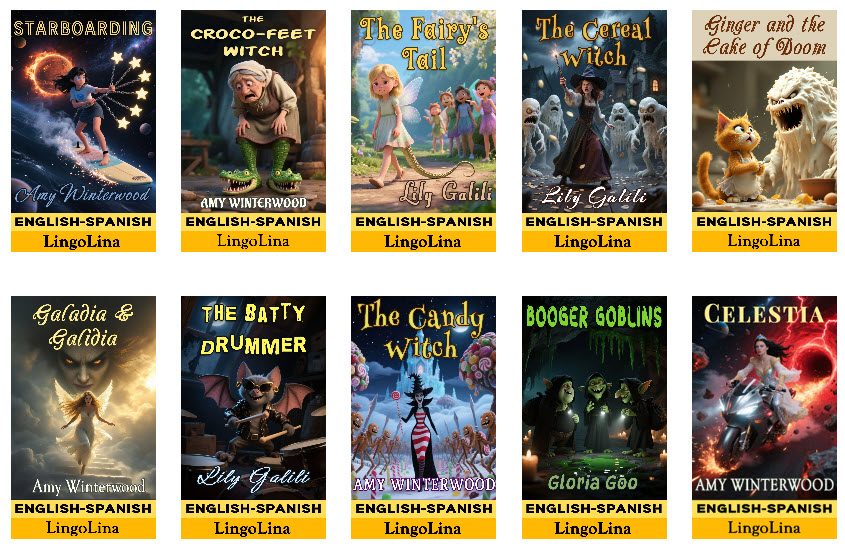
Learn Spanish Tonight with a Bilingual Story in Spanish and English from LingoLina
At LingoLina™, we designed our bilingual stories specifically with your child’s brain in mind.
Every sentence is first in English and then in Spanish. That way, your child always understands the story and never feels confused or overwhelmed.
Each story is rich in vivid descriptions, adventure, whimsical characters, humor, and emotion, and is paced perfectly for young learners.
The audio is clean and calm, so they can really hear what’s happening and picture it clearly.
And we recommend listening before bed or before a nap, so your child’s amazing sleep-brain can go to work filing those memories away like treasures.
You can read our stories for free with Kindle Unlimited or get them for as little as $0.99 each!
Visit LingoLina.com/stories to browse our full collection of fun stories for kids across all genres.
Common Questions Parents Ask About Teaching a 7YO Spanish
We tried pure immersion and my 7-year-old got frustrated. What now?
Switch to comprehensible input: movies with subtitles, favorite films dubbed in Spanish, and bilingual stories where each sentence appears in English first, then Spanish. Aim for “I get it!” before “I can say it perfectly.” Use pure immersion later at intermediate levels.
Can games really teach Spanish to a 7-year-old?
Yes, if Spanish is required to play. Use “Simón dice,” scavenger hunts with picture clues, and card games where taking a turn needs a phrase or sentence.
What progress is realistic for a 7-year-old in 3–6 months?
With daily 15–30 minutes of reading bilingual stories each day, and optionally supplementing with flashcards and grammar apps, expect your 7-year-old to reach an intermediate level where they can understand over 80% of words in children’s stories, comfortably listen to or read stories in pure Spanish without translations, understand around half of what they hear in everyday spoken Spanish, and speak at a basic level. Expect them to understand a lot more than they speak. Comprehension always comes befor speaking.
At 6–9 months, they’ll become more fluent and be able to speak more confidently and with fewer mistakes. Natural fluency can be expected between 12 to 16 months.
We tried Spanish before and quit. How do we restart with a 7-year-old?
Go tiny: one short story, one song, one daily routine. Track streaks (7 days, then 21) instead of “fluency.” Momentum beats intensity.
What’s a simple weekly Spanish plan for a 7-year-old?
Mon–Thu: 15-20 minutes (song, mini-story, chapter from a book, and a 3-word review). Fri: game night.
Sat: tutor or family “Spanish time.”
Sun: light review with a show and snacks.
My 7-year-old says Spanish is boring. How do I make it fun?
Try bilingual stories instead. If one story doesn’t interest your 7YO, don’t force them to go through it, pick a different one instead. Wrap it in their obsession (dinosaurs, space, witches, fairytales). Replace drills with missions: “Find three animal words on this page and act them out.”
Do 7-year-olds need a strict Spanish curriculum?
No, a consistent routine beats a thick workbook. Anchor Spanish to daily “tiny habits” (breakfast greeting, bedtime story). If your kid doesn’t engage with traditional learning materials, focus on only reading fun bilingual stories instead.
Should I worry about accent confusion at age 7?
No. Choose one accent you can support consistently (media/tutor). Variety can come later; kids adapt easily.
How do I track my 7-year-old’s Spanish without tests?
Use can-do checkpoints: “Describe a pet in 3 sentences,” “Order a snack politely,” “Retell the bedtime story in 4 short lines.”
What reading level is right for a 7-year-old learning Spanish?
Short chapters, lots of pictures, familiar topics, present-tense verbs, and repetition. If they can retell the page in simple English after reading, the level is right.
Can I learn Spanish alongside my 7-year-old?
Absolutely. Co-learning boosts consistency. Do the same lesson and trade roles: they read a line, you act it out, then swap. If you’re reading bilingual stories, all you need to do is listen to teh audiobook together or read the story together. As you read and listen, you’ll be learning the same way as your 7-year-old!
Is school Spanish enough for a 7-year-old?
It helps, but home exposure and supplementary bilingual content (story books, movies, songs) compound progress. Treat Spanish like reading time: short daily practice wins.
What if my 7-year-old is shy about speaking Spanish?
Lower the stakes: echo reading (you read, they echo), choral responses, or puppet “voices.” Let songs and “repeat-after-me” lines build comfort first.
How many new Spanish words should a 7-year-old learn weekly?
Think clusters, not counts. E.g., 8–12 words tied to one story or to one dinner routine. Recycle them in stories and games so they stick.
Is seven too late to start Spanish?
Not at all. Seven is a sweet spot: longer attention spans and basic reading skills, while still benefiting from child-like language absorption.
How much Spanish per day is right for a 7-year-old?
Aim for 15–30 minutes most days. Stack mini-moments such as song at breakfast, a movie with captions after school, a bilingual story at bedtime.
I don’t speak Spanish. Can I still teach my 7-year-old?
Yes. Use kid-friendly media, bilingual stories, captions, audiobooks, and (if possible) a weekly tutor or conversation partner to model pronunciation. You handle the routine; they model the sounds.
Are apps like Duolingo good for 7-year-olds learning Spanish?
They’re fine as a side dish for short vocabulary or grammar practice. Pair them with bilingual books, songs, and shows your child genuinely enjoys to avoid making Spanish learning dry and boring.
Should we hire a Spanish tutor for a 7-year-old?
A weekly 30-minute tutor or language exchange partner can boost confidence, pronunciation, and motivate your kid to improve their Spanish to better communicate with the tutor. Plenty of families teach their kids Spanish through stories, books, and movies alone. However, if you can afford a tutor, it can be an additional fun activity, like having a new nanny or friend who speaks Spanish.
Pick one who is warm, chatty, and smiley. Someone whom your kid genuinely enjoys seeing and chatting with.
How do I motivate a reluctant 7-year-old to learn Spanish?
Let interests lead the content. Pick stories your kid enjoys. Use flash cards with pretty colors and comic images not boring photos or plain text. Set quick wins (finish a mini-story, use three new words at dinner). And celebrate completion rather than perfection.
My 7-year-old keeps mixing Spanish and English. Should I stop it?
Code-mixing is normal early on. Encourage completing a thought in one language during practice blocks, and keep exposure steady.
How do we start Spanish at home if I only know the basics and my child is 7?
Pick one micro-routine (greetings at breakfast), one song on repeat, and one short story per week. Add a Saturday “Spanish walk” or game to make it special.
What works best for a 7-year-old: stories, songs, or flashcards?
Parents say stories are the most engaging for their kids, and both their kids and they learn Spanish easier adn faster with stories than with flash cards.
Use all three, but anchor flashcards to a story or song. Context drives memory at this age.
References
Cowan, N., Morey, C. C., AuBuchon, A. M., Zwilling, C. E., & Gilchrist, A. L. (2010). Seven-year-olds allocate attention like adults unless working memory is overloaded. Developmental Science. (PMCID: PMC2819460)
Peiffer, A., Brichet, M., De Tiège, X., Peigneux, P., & Urbain, C. (2020). The power of children’s sleep – Improved declarative memory consolidation in children compared with adults. Scientific Reports, 10, Article 9979. https://doi.org/10.1038/s41598-020-66880-3
Wilhelm, I., Diekelmann, S., & Born, J. (2008). Sleep in children improves memory performance on declarative but not procedural tasks. Learning & Memory, 15(5), 373–377. https://learnmem.cshlp.org/content/15/5/373.full.pdf
Wilhelm, I., Prehn-Kristensen, A., & Born, J. (2012). Sleep-dependent memory consolidation—What can be learnt from children? Neuroscience & Biobehavioral Reviews, 36(7), 1718–1728. https://doi.org/10.1016/j.neubiorev.2012.03.002
Baum, G. L., Ciric, R., Roalf, D. R., Betzel, R. F., Moore, T. M., … Bassett, D. S. (2016). Modular segregation of structural brain networks supports the development of executive function in youth. arXiv. https://arxiv.org/abs/1608.03619
Schommartz, I., et al. (2023). “From Learning to Remembering” — How Memory Consolidation Differs in Term and Preterm Children and Young Adults. [preprint].
https://www.biorxiv.org/content/10.1101/2021.08.24.457558v2
Cycowicz, Y. M. (2000). Memory development and event-related brain potentials in children. Biological Psychology, 54(1–3), 145–174. https://doi.org/10.1016/S0301-0511(00)00055-7
Gualtieri, S., & Finn, A. S. (2021). The sweet spot: When children’s developing abilities, brains, and knowledge make them better learners than adults. Perspectives on Psychological Science, 17(5). https://doi.org/10.1177/17456916211045971
Cheng, C., & Kibbe, M. M. (2022). Development of updating in working memory in 4–7-year-old children. Developmental Psychology, 58(5), 902–912. https://doi.org/10.1037/dev0001337

 LingoLina