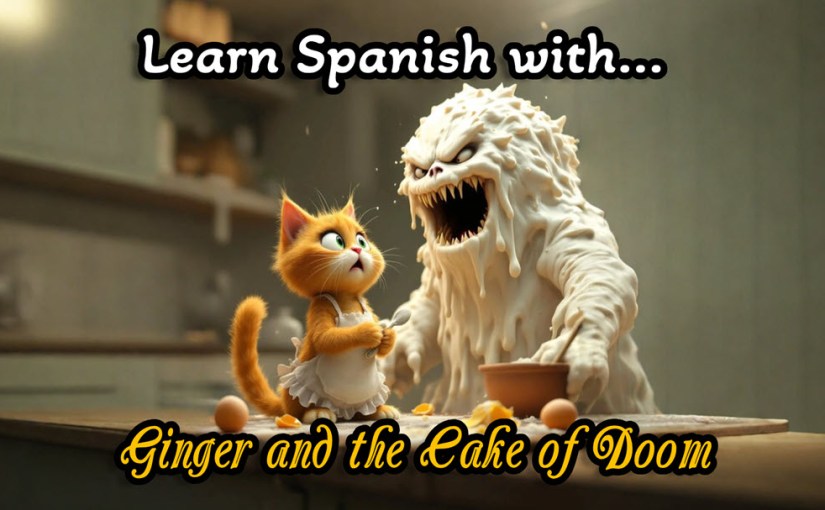
A flying cat, a vengeful cake, and a rescue mission across space… this is one Spanish lesson your kids will actually beg for.
What if learning Spanish felt like a wild adventure instead of a boring lesson?
Imagine your child laughing at a brave flying cat chasing a possessed cake through outer space, without realizing they’re also learning a new language.
That’s the magic of Ginger and the Cake of Doom by Lily Galili, a bilingual fantasy story from LingoLina™ that helps kids learn Spanish naturally through imagination, emotion, and laughter.
It’s one of those rare books that kids can’t put down, and parents secretly also enjoy just as much.
A Flying Cat, A Vengeful Cake, and a Spanish Lesson They’ll Actually Beg For
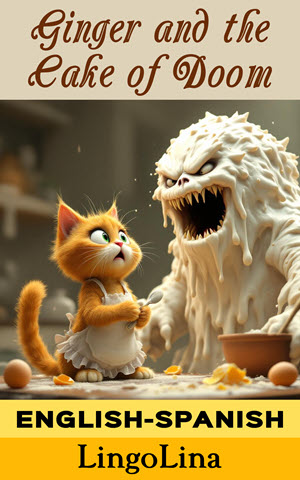 When Ginger the cat tries to bake her first cake, things go… galactically wrong.
The cake comes to life, kidnaps her owner, and blasts off into space, leaving a trail of frosting and fire behind. Armed with nothing but a wooden spoon, a flying mixing bowl, and one brave little heart, Ginger sets off on a rescue mission through worm-infested planets, fire demons, and cosmic chaos.
It’s a hilarious, fast-paced adventure packed with emotion, humor, and everyday Spanish vocabulary woven naturally through the story.
Readers pick up dozens of common phrases and food-related words, plus a few dramatic ones like “¡Sálvame!” (Save me!) without ever opening a grammar book or looking at hundreds of boring vocabulary flashcards.
You can get the book here on Amazon and discover our full library of bilingual stories for kids over here.
Why Story-Based Learning Works Better for Kids Than Traditional Spanish Lessons
Parents often ask, “Can my child really learn Spanish from a story?”
Yes, and science backs it up.
When we read or listen to a story, multiple parts of the brain light up at once: the language centers, the imagination circuits, and the emotional memory areas. That means every new Spanish word becomes tied to a feeling, an image, or a laugh, making it stick far longer in the long-term memory than isolated flashcards ever could.
The NeuroFluent™ Immersion Method used in LingoLina™ stories takes this even further. Every sentence appears first in English and then in Spanish, so the brain instantly links the familiar words and meanings with the new Spanish ones it hears.
This parallel, dual exposure creates what neuroscientists call Synaptic Language Linking; the natural connection between known concepts and new foreign words.
So while your child is laughing at Ginger’s really bad baking disaster, they’re also building a Spanish dictionary in their head and developing real bilingual understanding, without effort, memorization, or stress.
Why Teaching Kids Spanish Matters Now More Than Ever
Whether your family speaks English, Spanish, or both, learning Spanish is a lifelong gift.
Spanish is spoken by over 590 million people worldwide, and more than 42 million in the U.S. alone. It’s a language of opportunity in education, business, and travel.
When traveling, kids who understand Spanish can read signs, follow directions, and interact confidently. They can understand what people around them are saying and be safer wherever they are.
Bilingual children show stronger memory, creativity, and focus. They learn to switch between mental frameworks, an ability linked to higher academic performance.
Spanish opens doors to 20+ countries, cultures, and stories.
Learning Spanish together as a family creates memories and strengthens emotional bonds.
When Spanish becomes part of your child’s world through stories, songs, and play, it stops being a “subject” and becomes part of who they are.
How to Teach Your Child Spanish Without “Teaching”
The most effective way to help your child learn Spanish isn’t through lessons, it’s through consistent, enjoyable exposure to the language. Natural immersion.
Start simple:
Read or listen to a bilingual story every day, even for just 10 minutes. Ginger and the Cake of Doom makes it easy because each English line is followed by its Spanish version, keeping both child and parent in the loop.
You don’t need to “teach.” Just read, laugh, and enjoy the story.
If your child likes to act things out, encourage them to say their favorite lines in Spanish—dramatically!
A little daily joy adds up to huge progress.
Is It Okay to Read the Same Story Again and Again?
Absolutely, and you should!
Repetition is one of the most powerful tools in language learning. Each re-read reinforces vocabulary and grammar through what’s known as Spaced Repetition System, the brain’s natural process of strengthening memory through repeated exposure over time.
Every time your child revisits Ginger’s adventure, their brain re-encounters familiar words, recognizes new ones, and deepens connections.
Plus, when kids know what’s coming next, they can focus on listening and understanding instead of just following the plot.
So yes, let them read Ginger and the Cake of Doom ten times if they love it and want. It’s not “too much.” It’s reinforcing their mental Spanish dictionary.
How to Teach My Kid Spanish in a Bilingual or Mixed-Language Family?
If one parent speaks Spanish and the other speaks English, bilingual stories are an ideal bridge.
Here’s how to make it work:
The Spanish-speaking parent can read the Spanish lines, while the English-speaking parent reads the English ones.
If one parent is bilingual, they can switch fluidly between both versions for a seamless flow.
Storytime becomes a shared ritual that connects both languages—and both parents—with the child.
This approach replaces “language tension” with laughter and teamwork.
It also helps the child associate Spanish with comfort and family—not correction or pressure.
When Kids Refuse to Speak Spanish (And What to Do About It)
Many bilingual parents face this painful phase: their child understands Spanish but refuses to use it.
They answer in English, roll their eyes, or say “Just speak English, Mom!”
This isn’t rebellion, it’s emotion.
Children want to fit in with their peers. They may associate Spanish with “being different” or “being foreigners”.
The best remedy isn’t pressure, it’s joy.
Stories like Ginger and the Cake of Doom help reintroduce Spanish in a way that feels safe and exciting. When kids laugh and engage emotionally, the language becomes theirs again.
Even if they stay silent at first, the comprehension and connection are growing beneath the surface.
Let Spanish sneak back in through stories, songs, or audiobooks—quietly, joyfully, without confrontation.
Do I Need a Strict Spanish Learning Plan for My Kids?
Not at all. You need consistency, not a curriculum.
Every bilingual English-Spanish book your child reads expands their vocabulary.
Adventure stories teach action and dialogue.
Family tales teach relationships and emotions.
Nonfiction stories, like LingoLina™’s bilingual biographies about inspiring figures or ancient history series, build vocabulary around business, career, and values.
The key is to diversify what they read. Each genre adds a new layer of words and grammar patterns.
But one important tip:
Avoid reading only past-tense stories like “Once upon a time, she ran…” since they limit exposure to present or future tenses.
Include stories written in the present tense so kids learn how Spanish works in everyday speech.
So skip the rigid “lesson plan.” Just keep exposing your child to stories from different worlds, and enjoy the ride.
Homeschooling? Here’s How to Weave Spanish In
If you homeschool, Spanish can blend naturally into your child’s daily routine:
- Read bilingual stories during reading time.
- Let your child draw scenes from the book and label them in Spanish.
- Play the audiobook during art or snack time.
- Have a “Spanish Story Friday” where the whole family listens together.
How Long Until My Kids Start Understanding (or Speaking) Spanish?
Every child is different, but comprehension usually comes fast.
With daily exposure, kids can start recognizing words and phrases within weeks.
Speaking takes longer, and that’s okay.
Understanding always comes first. Speaking follows when confidence grows.
This “silent period” isn’t a delay, it’s the brain collecting enough data to speak naturally later.
One day, your child will surprise you by blurting out a full Spanish sentence you didn’t even know they knew.
Why Too Many Methods Can Slow Progress
It’s tempting to try every app, class, and course, but mixing too many systems can confuse kids.
Each method uses different vocabulary sets and teaching styles, making it hard for them to see progress.
It’s better to stick with a few enjoyable, high-quality resources like bilingual stories, songs, and audiobooks, and use them consistently.
Listening vs. Speaking Spanish: Why Listening Comes First for Kids
Parents often worry, “My child isn’t speaking yet, are they really learning?”
Yes! Spanish listening comprehension builds the foundation for speech.
Think of how babies learn: they hear thousands of words before saying even one.
The same applies to language learners.
Audiobooks, stories, and songs fill their mental “word bank.” When it’s full enough, speech begins effortlessly.
Moving from Passive to Active Learning Spanish
Once your child understands most of what they hear, you can gently invite them to use it.
Ask playful questions like:
“What do you think Ginger will do next?”
“Can you say ‘Run!’ in Spanish like Ginger does?”
Repetition through fun builds confidence, and confidence leads to output.
Let speech come from excitement, not expectation.
When Nothing Seems to Work and Kids Don’t Want to Learn Spanish
With traditional Spanish lessons and courses, many parents hit a wall eventually. Kids get bored, resist new routines, or lose interest.
When that happens, humor is your secret weapon.
Put away the apps and bring back joy.
Read funny, whacky, whimsical, or exciting bilingual adventure stories together such as Ginger and the Cake of Doom, laugh out loud, and let the story do the rest.
Once kids feel entertained instead of pressured, their brains open up, and the language flows in naturally.
How to Integrate Spanish “By Accident” Into Daily Life for Immersion
The best kind of learning often happens without trying.
- Play Spanish audiobooks during car rides.
- Switch one movie night a week to Spanish audio.
- Sing Spanish versions of familiar songs.
- Ask your child, “How do you think Ginger would say this in Spanish?”
When Spanish becomes part of normal life, it stops being something to learn—and becomes something to live.
Conclusion: The Most Fun Way to Teach Kids Spanish
Learning Spanish doesn’t need to feel like school; it can feel like a fun adventure.
With Ginger and the Cake of Doom, your child gets adventure, humor, imagination, and a growing Spanish vocabulary all in one.
It’s proof that laughter and learning can go hand in hand, and that it’s never too late to start.
Grab a spoon, open the book, and join Ginger’s rescue mission across the stars.
Because this might just be the funniest, sweetest way your family ever learns Spanish.
You can get this hilarious, exciting adventure story on Amazon.
LingoLina offers many more funny, action-packed stories for kids of all ages. Check out our full library of language learning books here.

 LingoLina