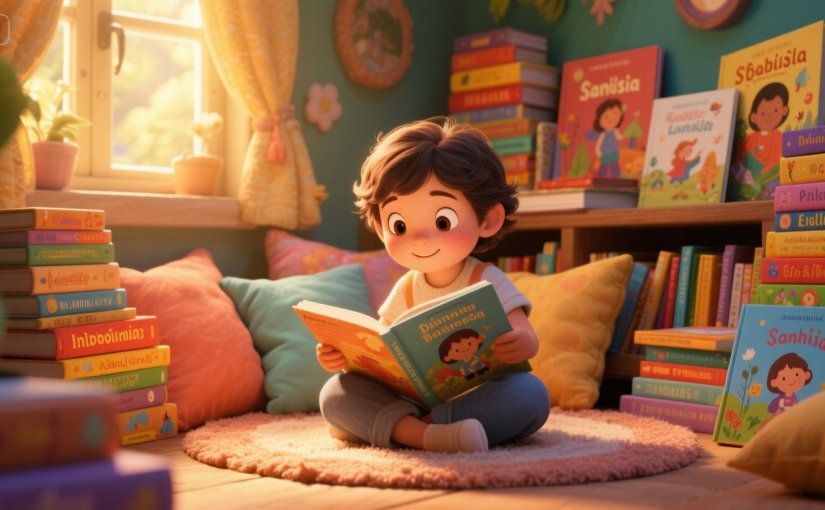
Every parent who’s ever tried to teach their child Spanish knows the frustration. Flashcards don’t stick, grammar drills cause groans and yawns, and language apps often feel like more schoolwork.
You want your child to enjoy learning Spanish, not dread it. The good news? There’s a gentler, smarter way: through fun stories.
Bilingual fiction books for kids in Spanish and English turn language learning into an adventure. Instead of memorizing words, kids pick them up naturally as they follow a magical tale.
It feels like storytime, not study time.
The Science Behind How a Child’s Brain Learns Spanish Naturally through Bilingual Stories
Children’s brains are wired to learn languages through meaning, not memorization. When they hear or read a story they understand, they vividly imagine the scenes, visuals, and sounds. A Harvard study found stories are remembered 22 times more than facts alone.
When you read a bilingual story book with first the English and then the Spanish version of the story (especially when it’s a sentence-by-sentence translation like LingoLina offers), your kid’s brain will automatically start linking new sounds to familiar ideas and words.
When kids try to memorize Spanish words or phrases the traditional way—by repeating them over and over—they might remember them for a test, but those words often disappear just as fast. That’s because rote memorization mostly taps into short-term memory. It’s like writing in sand: one wave and it’s gone.
Stories, on the other hand, work completely differently inside a child’s mind. When a story is vivid and full of sensory detail, the brain lights up in many places at once. The parts that process sights and sounds imagine the scene. The emotional center (the amygdala) gets involved when something emotional, funny, exciting, thrilling, or touching happens. All those regions start firing together, building strong neural pathways that anchor the new Spanish words in context.
Instead of storing random sounds, the brain now ties each Spanish word to an image, a feeling, and a moment. That connection forms a kind of mental map, a structure that makes it easy to recall later. Research shows stories are more than twenty times as memorable as isolated facts because they give meaning to what we learn.
So when a child learns through stories, they’re not just memorizing vocabulary; they’re living it. Every new word becomes part of an adventure, linked to sights, emotions, and imagination. That’s why bilingual stories make learning Spanish feel so natural: the language isn’t forced into the brain; it grows there, one magical moment at a time.
No baby is given a phrase book and a grammar book. They learn through sights and sounds and repetition. Learning through stories (aka Contextual Input learning) is the same effortless process they used to learn their first language.
The problem with trying to read a pure Spanish book to a kid who doesn’t understand Spanish, is that they can’t follow along, they get overwelmed and distracted, and they can’t imagine the scenes because they don’t know what’s being said.
Bilingual books give the brain exactly what it needs: context. A sentence appears first in English, then in Spanish. The child immediately connects the two and understands what’s happening. The English version helps your child imagine the scene, while the unfamiliar Spanish version anchors new words with those visuals. Over time, the brain recognizes patterns, builds associations, and remembers new Spanish words without trying.
Researchers have found that both sides of the brain engage during bilingual reading: the left for logic and language, the right for emotion and imagery. That combination is powerful. It means your child isn’t just decoding vocabulary; they’re feeling the story, forming memories, and absorbing language on a deeper level.
When a child hears a story first in their native language and then in Spanish, something remarkable happens inside their brain. It’s a process we call Synaptic Language Linking.
The brain already has a huge library of familiar words in long-term memory. When it hears a sentence in English, it instantly understands it using those existing memory networks. Then, when the same sentence appears in Spanish, the brain connects the new sounds to the familiar meaning—like drawing a bridge between two islands. These connections are formed in what scientists call the semantic memory network, which links ideas and concepts stored over time.
It’s almost as if the brain is quietly building a personal bilingual dictionary in the background—without any conscious effort or memorization.
When the child hears a familiar word in their own language, areas like the temporal lobe and Wernicke’s area light up to process meaning. The word “sun,” for example, might trigger the visual cortex to picture warm light or the amygdala to recall a happy feeling from a summer day. Hearing the Spanish word sol immediately afterward helps the brain associate that same concept with a new sound. The existing memory becomes an anchor point, and the new Spanish word latches onto it.
This is called associative learning—and it’s very powerful. The brain uses its natural ability to connect new information to what it already knows. At the same time, dual coding takes place: the child processes both the verbal sound and the mental image, storing them in different parts of the brain. When neurons fire together like this, they literally wire together, strengthening memory pathways.
Using Bilingual Stories for Spanish Immersion Without Stress
Traditional Spanish immersion can be intimidating for beginners. When a child can’t understand what’s being said, their brain reacts with stress or frustration. That stress raises what linguists call the affective filter—a mental barrier that blocks learning. It’s why so many children give up when they feel “bad” at languages.
Bilingual stories lower that barrier completely. Because the child always hears the English version first, their mind relaxes. They know exactly what’s happening in the story before hearing it in Spanish. That sense of calm keeps the brain open and receptive. The result is comprehensible input—language that’s always understandable, never overwhelming. In that relaxed state, the brain absorbs new words like a sponge.
The Magic of Passive, Implicit Learning through English-Spanish Stories
Even when a child is listening casually—while drawing, playing, or relaxing—their brain is still hard at work. The auditory centers keep processing the Spanish sounds, and over time, the brain begins to recognize recurring patterns and phrases automatically.
This is called implicit learning: picking up language naturally without conscious effort. It takes place deep in the brain’s basal ganglia, the same system that helps us master skills like riding a bike or playing an instrument. Unlike explicit memorization, which relies on short-term memory and often fades, implicit learning builds long-term fluency through exposure and repetition.
So when your child listens to bilingual English-Spanish stories over and over, they’re training their brain to understand Spanish naturally, just as they once learned their first language.
Why Bilingual Books Help Kids Learn Spanish Faster than Courses or Apps
When kids can see each line in both English and Spanish, they never feel lost. There’s no flipping to a dictionary, no guessing, no stress. That constant sense of understanding keeps motivation high and frustration low.
Every chapter reinforces vocabulary naturally. Instead of isolated word lists, words live inside sentences, attached to feelings, images, and events. This kind of learning is sticky—it stays in the brain because it’s meaningful.
Bilingual Spanish-English books also build confidence. Even beginners can follow along and finish a story. That feeling of success is what keeps them coming back. Over time, the rhythm and flow of Spanish start to feel familiar. Kids begin recognizing repeated words and phrases, almost without realizing they’re learning.
LingoLina™ uses a special method called the NeuroFluent™ Immersion Method, designed to help your child learn a new language easily and naturally. In every story, each sentence appears first in your child’s native language and then in the language they’re learning.
This way, your child always understands what’s happening, and their brain naturally connects the two languages without stress or confusion. There’s no flipping between pages or guessing what words mean—just a smooth, enjoyable reading experience.
As your child follows the adventure, they’re not memorizing vocabulary or grammar rules. They’re simply hearing and reading the story in two languages, letting new words and phrases sink in naturally. It feels effortless—like the language is being absorbed while they’re having fun.
How Reading and Listening to Spanish Together Makes Learning Faster
If you combine bilingual reading with listening, say, an audiobook or podcast version, or reading it out loud yourself if you don’t have an audio version avialable, you create a double impact. The eyes see the text while the ears hear the pronunciation, tone, and rhythm.
Listening helps kids tune their ear to natural Spanish sounds.
Reading reinforces what they hear.
Together, they train both comprehension and pronunciation far faster than either alone.
Even ten minutes a day of reading and listening to Spanish stories can make a remarkable difference in fluency over time.
How to Teach Your Kid Spanish If You Don’t Speak Spanish as a Parent?
Many parents worry: “How can I help my child learn Spanish if I don’t speak it myself?” The beauty of bilingual books is that you don’t have to. You can learn right alongside your child.
Start by reading the English line first, then the Spanish one. Repeat together, even if your pronunciation isn’t perfect. Listen to the audiobook or podcast version to hear how it’s said. The goal isn’t perfection, it’s exposure and enjoyment. Your child will see you modeling curiosity and persistence, which matters far more than getting every word right.
Common Mistakes Parents and Teachers Make When Teaching Kids Spanish
When teaching kids a new language, good intentions can easily backfire. Many parents turn fun reading into a stressful lesson without realizing it. Quizzing vocabulary after each chapter or correcting every mispronounced word kills curiosity. Let the mistakes slide; fluency grows from repetition, not correction.
Another common trap is forcing a child to read books they don’t enjoy. Interest drives memory. If your child loves dragons, mysteries, or magical adventures, choose stories that fit those passions.
Some parents jump straight into “pure immersion”; all-Spanish books far above the child’s level. While full immersion works for advanced learners, it overwhelms beginners and causes stress, confusion, and frustration.
Bilingual stories meet them halfway, letting them understand everything while slowly expanding their Spanish vocabulary.
Avoid comparing your child’s progress with others. Language learning isn’t a race. What matters is consistent exposure and a positive emotional connection to the language. And remember, even reading for ten minutes daily is better than cramming once a week.
The biggest mistake of all is turning language into homework. Kids learn best when they’re relaxed, laughing, and curious, not when they feel tested or judged. Treat storytime as playtime, and you’ll see their Spanish bloom naturally.
How to Make Learning Spanish Fun, Stress-Free, and Effective for Kids
The secret to long-term success is keeping it joyful. Let your child choose the stories. Read together before bed or on lazy weekend mornings. Make it a cozy, shared ritual rather than a school task.
If your child loves fantasy, pick bilingual adventure books with magic, mystery, or humor. When kids care about what happens next, they stop thinking about the Spanish words, they just feel the story. That’s when true fluency begins to form.
Encourage rereading favorite tales. Familiar stories reinforce vocabulary without boredom because the brain recognizes patterns faster each time. You can also alternate formats: read a chapter one day, listen to the audiobook the next, then discuss what you both understood.
Fluency grows through immersion in emotion and meaning. Keep the atmosphere light, encouraging, and full of discovery.
Common Myths About Learning Spanish Through Stories
Some parents worry that bilingual books might slow down learning because the English “gets in the way.” In reality, it’s the opposite. The translation gives meaning instantly, allowing the child to relax and focus on sound, rhythm, and sentence flow.
Another myth is that grammar must come first. Children who read bilingual stories absorb grammar patterns subconsciously, just like native speakers do. They don’t memorize rules; they sense what “sounds right.”
Total immersion is often praised as the fastest path to fluency, but for kids it can be too steep. Without context, they get lost and discouraged. Bilingual stories provide a bridge, offering the best of both worlds: natural immersion and full understanding.
And no, parents don’t need to be fluent. With bilingual texts and matching audio, anyone can guide a child’s Spanish journey confidently.
Where to Find Great Bilingual Books to Teach Kids Spanish
Look for bilingual chapter books that match your child’s interests and reading level. Libraries and bookstores often have dual-language sections, and many bilingual fantasy series are now available on Kindle or in audiobook form.
LingoLina™ publishes exciting stories for kids of all ages, across multiple genres. Our patent-pending NeuroFluent™ Immersion method uses clear paired sentences (English immedately followed by Spanish) so comprehension is effortless.
Fantasy adventures, mysteries, and humorous tales tend to work best for middle-grade readers because they captivate imagination while introducing diverse vocabulary.
Our books are specifically designed for young language learners, with accompanying audiobooks and podcasts available to help your kid improve both reading and listening skills. They’ll become fluent in understanding spoken Spanish, speaking it, and reading Spanish.
How to Get the Most Out of Bilingual Books for Kids Learning Spanish
Short, frequent sessions are better than long ones. Even fifteen minutes a day keeps the language fresh in your child’s mind.
Alternate days between reading in English and Spanish, or read both versions aloud together.
Consistency and enjoyment matter far more than perfection. The more your child associates Spanish with fun and connection, the faster fluency develops.
Choose books that your kid enjoys. If your daughter loves stories about witches, find bilingual witch stories for her to enjoy. If your son loves action adventure stores, find bilingual books in that genre to keep him engaged and make reading fun and exciting.
Once your kid finishes one book, don’t start drilling them on vocabulary and grammar like an exam at school. Instead, give them the next book to read to reinforce the words they learned and help them continue learning.
Parents’ Most Common Questions Answered about Teaching Kids Spanish through Stories
Can my child really learn Spanish just from stories?
Yes. Stories provide repeated exposure to natural language in context, which is how the brain acquires meaning. It’s slower than memorizing a list—but infinitely more lasting and enjoyable.
What if my child mixes English and Spanish?
That’s normal. Mixing, or “code-switching,” shows their brain is actively connecting both languages. Over time, they’ll learn when to use which one naturally.
How long before I notice progress teaching my kids Spanish?
Most parents notice recognition of simple words and phrases within a few weeks of consistent reading. Fluency builds gradually over 6 months through daily exposure.
Are bilingual books better than language apps to teach kids Spanish?
Apps teach isolated words; stories teach how language works in real life. They build comprehension, rhythm, and emotion, things apps can’t replicate.
Should I translate for my child or let them guess?
Let the bilingual text do the work. Read both versions and discuss meaning casually. Avoid over-explaining; the brain learns faster from pattern and repetition.
Can stories in Spanish improve pronunciation?
Yes, especially when paired with listening. Hearing native speakers while reading helps kids internalize natural pronunciation and intonation.
Is listening more important than reading when learning Spanish?
Both matter. Listening trains the ear; reading reinforces visual memory. Combined, they accelerate fluency dramatically.
What if my child forgets new Spanish words quickly?
Repetition through stories solves that. Spanish words return naturally across different contexts, strengthening long-term memory.
How can I keep my child motivated to continue learning Spanish?
Let curiosity lead. Choose fun fantasy plots or adventurous bilingual stories. When the story pulls them in, motivation takes care of itself.
Do bilingual Spanish fantasy stories work better than realistic ones?
For many kids, yes. Fantasy engages imagination and emotion, creating stronger memory links. But any engaging, fun story your child loves will work.
Should I correct mistakes when reading Spanish aloud to my kid?
Only gently and rarely. Focus on communication, not perfection. The goal is exposure, not accuracy drills.
Can I learn Spanish too while helping my child learn the language?
Absolutely. Parents often pick up vocabulary and pronunciation just by reading together daily. It becomes a shared learning journey.
What if my child is shy about speaking Spanish?
Start with reading and listening only. Once they feel comfortable understanding, speaking will come naturally without pressure.
Are there bilingual audiobooks for kids?
Yes, many bilingual Spanish English stories are now available as audiobooks and podcasts. Listening to the narration while following the text reinforces both comprehension and pronunciation.
Do I need to buy a specific level of book to teach my kid Spanish?
Choose something slightly below your child’s reading level so they feel successful. Confidence fuels progress far more than difficulty does.
Conclusion: Raising Natural Spanish Speakers
Fluency doesn’t come from memorizing lists or passing quizzes—it grows from curiosity, repetition, and joy. Bilingual stories offer all three. They allow kids to understand instantly, connect emotionally, and absorb Spanish the same effortless way they learned their first language.
Reading and listening to bilingual fantasy adventures a few minutes a day can quietly transform how a child hears, speaks, and thinks in Spanish. Whether you’re fluent yourself or learning alongside them, stories create the bridge to bilingual confidence.
When learning feels like magic, progress follows naturally. That’s the real secret to helping children fall in love with Spanish—one story at a time.

 LingoLina