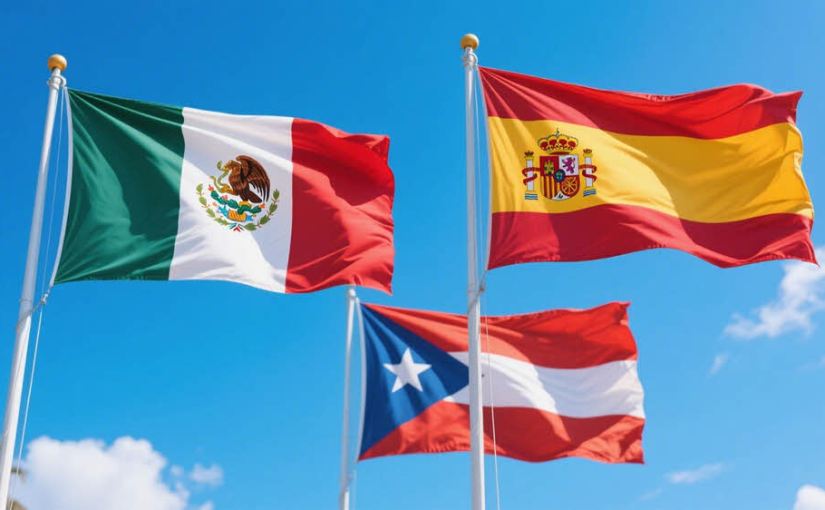
When parents start looking for ways to teach their kids Spanish, they often discover something surprising: there isn’t just one kind of Spanish.
Between Europe and Latin America, Spanish has many accents, slang words, and small grammatical differences. That’s exciting but also confusing.
If your child is learning Spanish, should they learn the version spoken in Spain or the one heard across Latin America?
The short answer: both are beautiful and mutually understandable. But depending on where you live, travel, or imagine your child’s future, one may make more sense.
How Spanish Differs Around the World
Spanish is spoken by over 590 million people worldwide, making it the second most spoken native language after Mandarin.
Roughly 455 million of all Spanish speakers live in Latin America, the United States, and Canada, compared to around 47 million in Spain.
Just as English sounds a bit different in London, New York, or Sydney, Spanish varies too. The grammar remains almost identical, but pronunciation, expressions, and rhythm change from country to country.
For language learners—especially children—these differences affect how easy it is to understand, pronounce, and use new words. That’s why choosing the right variant at the start helps your child feel confident and comfortable.
The Main Differences Between Latin American and European Spanish
Pronunciation.
In Spain, the letters c (before e or i) and z are pronounced like a soft “th” sound: grathias, thereza.
Across Latin America, both are pronounced as an “s”: grasias, sereza.
For beginners, the Latin American pronunciation feels simpler and matches spelling more closely.
Vocabulary.
Some everyday words differ. Latin Americans say carro and celular, while Spaniards say coche and móvil.
Neither is “right” or “wrong,” but a few differences can confuse new learners.
Grammar.
Spain uses the informal plural “you all” form, vosotros, while Latin America sticks to ustedes for everyone.
For children and parents learning together, Latin American Spanish grammar rules make things easier.
Accent and speed.
Spain’s accent is sharper and often faster; Latin American accents are generally smoother and easier to follow.
For new learners, the slower rhythm of Latin American Spanish is gentler on the ear.
Which Type of Spanish Is Easier for Kids to Learn?
Children learn by connecting sound to meaning.
Latin American Spanish tends to be more phonetic; words are pronounced almost exactly as they’re written. That helps kids recognize patterns quickly when reading or listening.
Because pronunciation is clear and consistent, early learners make fewer mistakes, remember words longer, and gain confidence faster. Once they’re fluent, switching to other accents later is easy because their brain already knows the structure and words.
Which Spanish Will Be More Useful for Your Child’s Future Career?
Think ahead a little: where will your child live, study, or work one day?
If you’re in the United States or Canada, learning Latin American Spanish is by far the most practical choice.
Over 42 million people in the U.S. speak Spanish, mostly from Latin American backgrounds. That number grows every year. Your child may have classmates, college friends, coworkers, clients, or even employees who speak Latin American Spanish.
Spanish fluency can open doors in almost any field—healthcare, law, education, engineering, tourism, and international business. Even entrepreneurs benefit; Latin America is a fast-growing market, and being able to communicate with clients or suppliers in their language is a huge advantage.
If you live in the UK or Europe and your child might one day work or study in Spain, learning European Spanish could make sense.
But for families in the Americas, Asia, or Australia, neutral Latin American Spanish is usually the best long-term investment: it’s globally understood and immediately useful in business, travel, and culture.
Does Location Matter When Choosing Spanish for Kids?
Absolutely.
If your family lives in, travels to, or has relatives in the Americas, Latin American Spanish will feel familiar and relevant.
Maybe you vacation in Mexico, Costa Rica, or Panama—or perhaps you plan to retire somewhere with sunshine and affordable living costs. In those regions, speaking Latin American Spanish will enrich every experience.
Spain Spanish fits naturally if you’re based in Europe or have strong ties there. But even in Europe, many teachers now prefer neutral Latin American accents because they’re easier for children to understand.
For most global families, especially in the U.S., Canada, or Asia, Latin American Spanish covers far more ground.
Which Type of Spanish Is More Widely Spoken and Useful?
Numbers tell the story clearly:
- Latin America + North America: ~455 million native Spanish speakers.
- Spain: ~47 million native speakers.
That means Latin American Spanish is nearly ten times more common.
It’s what you’ll hear in most Spanish-language media; songs, shows, podcasts, and even bilingual storybooks.
Because of this reach, most modern programs (including LingoLina™) use a clear, neutral Latin American accent so learners everywhere can understand it easily.
Which Spanish Do Schools and Language Programs Teach?
If your child attends school in the U.S. or Canada, chances are they’re already learning Latin American Spanish.
Most North- and South-American curricula teach this version because it matches the language spoken locally.
In Europe, lessons sometimes focus on Spain Spanish, though many programs have shifted to a neutral international form.
Bilingual books, songs, and stories from LingoLina™ follow this same neutral Latin American standard, making them accessible to children worldwide.
How to Choose the Right Spanish Which Fits Your Family
Start by asking yourself a few questions:
- Where do we live, and where might we move in the future?
- Who will my child talk to most—friends, relatives, classmates, teachers?
- What Spanish-speaking countries do we visit or interact with?
If your daily life or career circles touch the Americas in any way, Latin American Spanish is usually the smartest choice.
If your ties are mainly European, Spain Spanish works just fine.
The key is consistency. Once your child is fluent, switching accents will be natural.
Can Kids Learn Both Versions of Spanish?
Yes! But it’s best to master one first.
When children have a solid base in vocabulary and pronunciation, they can easily recognize regional differences later. Exposure through media and travel will gradually tune their ear to both.
Bilingual audiobooks and paired-sentence stories—like those from LingoLina™—help with this flexibility because they teach comprehension, not memorization. Once understanding is automatic, accent adjustments become effortless.
How Media and Stories Reinforce Accent and Understanding
Children absorb accent subconsciously through repetition and emotion.
Songs, cartoons, and bilingual audiobooks are powerful tools for this reason.
Audiobooks help them hear pronunciation clearly, while bilingual stories connect meaning to sound.
If you want to get started teaching your kid Spanish, LingoLina offers a variety of fun, exciting bilingual stories and audiobooks read in a neutral Latin American Spanish accent.
Parent FAQs: Choosing Between Latin American and Spain Spanish
What’s the main difference between Latin American and Spain Spanish?
Pronunciation and vocabulary. Latin America says grasias, Spain says grathias. Grammar is almost identical.
Which Spanish is easier for kids to learn?
Latin American Spanish, because pronunciation matches spelling and sounds are softer.
Which type is spoken by more people?
Latin American Spanish—around 455 million native speakers versus 47 million in Spain.
Can my child use Latin American Spanish in Spain?
Yes, completely. Both versions are mutually intelligible.
What kind of Spanish do schools in the U.S. teach?
Mostly Latin American or neutral Spanish.
Is one version of Spanish more “correct”?
No. They’re equally correct, just regional variations like U.S. and British English.
Which Spanish is best for families in America or Canada?
Neutral Latin American Spanish—it matches local communities and real-world use.
Should we learn Spain Spanish if we live in Europe?
If you’re in the EU or travel often to Spain, yes. Otherwise, neutral Latin American Spanish is globally safer.
Can children mix accents while learning?
Yes, but it’s better to focus on one first to avoid confusion.
Why do some programs choose Latin American Spanish?
It’s clearer for beginners, widely understood, and matches global media content.
Which Spanish accent is used in music and movies?
Most songs, telenovelas, and global Spanish-language media use Latin American Spanish.
Which Spanish helps most in future careers?
Latin American Spanish, especially for kids growing up in North America, it’s the most practical for business.
What accent does LingoLina™ use?
A clear, neutral Latin American accent that children around the world can understand.
Can bilingual stories help with pronunciation?
Yes—they let kids hear accurate pronunciation while linking it to meaning, improving memory and speech naturally.
How can parents practice with their kids?
Listen to short bilingual stories or songs together daily. Even 10 minutes a day builds lasting understanding.
Practical Tips to Reinforce the Type of Spanish & Accent You Choose to Teach Your Kids
Listen to Spanish audiobooks or story podcasts together each day.
Watch cartoons or movies in the same accent your child is learning.
Keep exposure consistent—avoid switching back and forth early on.
Sing songs in Spanish; rhythm helps memory and pronunciation.
Celebrate progress, not perfection—every bit of exposure counts.
Conclusion: Pick the Type of Spanish That Fits Your Family and Stay Consistent
Both versions of Spanish are rich, musical, and valuable. The best choice depends on where you live and who your child will interact with most.
For most global families, especially those in the U.S., Canada, and Latin America, neutral Latin American Spanish is the clearest, easiest, and most useful option.
It’s practical for school, travel, business, and everyday life, and your child will still understand speakers from Spain when they meet them later.
The most important part isn’t the accent, but the joy of learning together.
If you’d like an easy way to begin, LingoLina’s exciting bilingual stories and audiobooks use a neutral Latin American accent, helping parents and kids learn Spanish naturally, enjoyably, and without stress.

 LingoLina