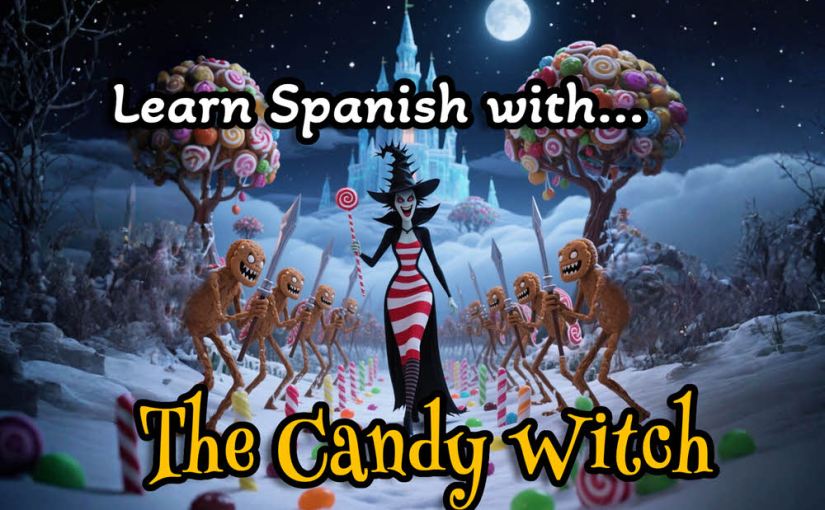
Imagine your child giggling through a fantasy story about gingerbread soldiers, enchanted snowflakes, and a villainous witch obsessed with cursed candy—without realizing they’re also learning Spanish.
That’s exactly what happens in The Candy Witch, a bilingual fantasy adventure from LingoLina™ that turns language learning into a magical family experience.
What’s The Candy Witch About?
It’s a stormy winter night, and Roy is bored. Then an enchanted snowflake drifts into his room and whisks him away to a frozen world above the clouds. He finds himself trapped in a creepy candy castle where children are hypnotized, sinister mice play flutes, and a Candy Witch with wicked plans rules over an army of gingerbread soldiers.
The witch has magic. The gingerbreads have weapons. And Roy? All he’s got… is a celery stick.
What unfolds is a hilarious, slightly spooky, and wildly imaginative adventure that kids (and parents) can’t stop reading.
There’s a snowball fight, a veggie battle, and plenty of clever twists—all while gently teaching Spanish sentence by sentence.
It’s perfect for kids aged 7–12, especially those who love fantasy, humor, adventure, and a touch of mischief.
And yes, it might even make them look at vegetables a little more fondly.
Preview the first two chapters here.
Get The Candy Witch book on Amazon.
Learn more about all of our exciting bilingual kids’ books at LingoLina.com/stories.
Why Stories Like The Candy Witch Are So Effective for Learning Spanish
Parents often ask, “Can a story really teach my child Spanish?”
The answer is yes—when the story is built around natural bilingual immersion instead of forced lessons.
In The Candy Witch, every sentence appears first in English and then in Spanish. This format, called the NeuroFluent™ Immersion Method, creates an instant bridge of meaning.
Children understand the sentence right away, then hear it again in Spanish, and their brain automatically links the two.
It’s not memorization, it’s natural absorption.
This approach builds comprehension, vocabulary, and fluency without stress. The story keeps them emotionally engaged, which strengthens memory and language recall.
So while your child is cheering for Roy and laughing at the gingerbread army, their brain is quietly wiring itself for Spanish.
Why Teach Kids Spanish at All?
There’s no doubt that bilingual kids enjoy major advantages, both now and in the future.
1. Career Opportunities.
Spanish is spoken by over 590 million people worldwide, including more than 42 million in the U.S. It’s a key business language across the Americas, Europe, and even parts of Asia.
Whether your child becomes a doctor, entrepreneur, engineer, or artist, knowing Spanish opens countless professional doors.
2. Safety and Awareness.
When traveling—or simply living in multilingual communities—understanding Spanish helps kids follow signs, announcements, and conversations. It gives them confidence and a sense of belonging.
3. Cultural Connection.
Learning Spanish connects children to diverse cultures, traditions, and stories across more than 20 countries. It helps them see the world with empathy and curiosity.
4. Brain Development.
Numerous studies show bilingual children have stronger memory, problem-solving skills, and creativity. Learning another language enhances focus and builds long-term learning resilience.
5. Family Bonding.
When parents learn alongside their kids—through books like The Candy Witch—it becomes quality time instead of homework. Families share laughter, new words, and magical stories together.
Comparing Different Ways Kids Learn Spanish
There are many paths to fluency—but not all are equal in fun or effectiveness.
Flashcards and Grammar Drills
- Pros: Build vocabulary fast.
- Cons: Boring, repetitive, and easily forgotten. Kids memorize words but don’t understand how to use them in real life.
Apps and Games
- Pros: Interactive and colorful.
- Cons: Often disguised drills. Great as short supplements, but not enough to build true fluency.
Songs and Music
- Pros: Perfect for rhythm, pronunciation, and cultural immersion.
- Cons: Lyrics are usually too fast or poetic for absolute beginners. Better once some comprehension exists.
Cartoons and Movies
- Pros: Fun and visual.
- Cons: If kids don’t know the story, they get lost quickly. Best for intermediate learners or for rewatching favorite movies in Spanish.
Bilingual Books and Audiobooks
- Pros: Combine story, context, and comprehension. Kids learn words in full sentences and meaningful scenes.
- Cons: Require short, regular exposure to be effective—like 10–15 minutes a day.
That’s why The Candy Witch works so well: it blends fun storytelling with scientifically designed bilingual structure, ensuring your child learns naturally while being completely entertained.
How the Brain Learns Spanish Naturally Through Stories
Stories engage emotion, imagination, and language processing at the same time.
When kids care about what happens next, their brains release dopamine, the “feelgood” and curiosity chemical, which boosts memory and learning.
Hearing each sentence first in English, then in Spanish, creates what linguists call Synaptic Language Linking; the brain connecting meaning to sound. The English version provides the meaning, the Spanish version provides the new sounds. Over time, these links strengthen until understanding becomes automatic.
That’s why bilingual storytelling is such a powerful learning tool: it connects what you already know with new words you don’t know. It activates the emotional and logical parts of the brain simultaneously, making it faster to learn new words and making those new words stick for good.
How Families Can Learn Spanish Together Through Shared Storytime
Parents often worry, “But I don’t speak Spanish. How can I help my child learn?”
That’s the beauty of bilingual stories. You don’t need to be fluent.
When you read The Candy Witch together, you understand every line instantly thanks to the English text, while the Spanish naturally follows.
You’ll start recognizing words, patterns, and phrases yourself, without even trying.
Listening to the bilingual audiobook version makes it even easier. You can play it in the car, at bedtime, or while cooking dinner. The clear, neutral Latin American accent helps children and parents alike absorb correct pronunciation.
It’s not just a story, it’s a shared adventure that doubles as language immersion.
What Parents Ask Most About Learning Spanish Through Stories
Can my child really learn Spanish from a story?
Yes. Stories give language meaning, emotion, and repetition—three keys for long-term memory.
What age is The Candy Witch best for?
Ages 7–12, though younger kids love listening along with parents.
Do I have to speak Spanish to read it with my child?
Not at all. Every line includes the English sentence first, so you’ll both follow easily.
How long should we read each day?
Even 10 minutes a day builds progress. Consistency is more important than time spent.
Is the story scary?
It has a few mild spooky scenes (a witch, gingerbread soldiers, and a veggie battle), but it’s written to be funny and whimsical, not frightening.
Does it actually teach grammar?
Yes—indirectly. Kids absorb grammar naturally from sentence structure and repetition.
Can I use it if my child is a total beginner?
Absolutely. It’s designed for total beginners through intermediates.
What type of Spanish and accent does the audiobook use?
The book uses a regular Latin American Spanish. The audiobook uses a neutral Latin American accent, clear and easy to understand globally.
Can this book help me learn Spanish too?
Yes! Parents often pick up vocabulary quickly by reading or listening with their kids.
How is this different from other bilingual books?
Traditional bilingual books use full English and Spanish pages side by side, forcing the reader to flip back and forth. The Candy Witch uses sentence-by-sentence pairing for seamless comprehension.
How to Combine Books with Other Spanish Learning Tools
To help Spanish stick and make learning fun:
- Read or listen to a bilingual story daily. Consistency is key.
- Sing simple Spanish songs. Music reinforces rhythm and pronunciation.
- Watch cartoons your child already knows—but in Spanish. Familiar plots make it easy to follow.
- Use flashcards only as quick reviews. Keep the main learning rooted in stories and real sentences.
- Talk about what you read. Ask, “What do you think la bruja de los dulces will do next?”—encouraging natural conversation.
The more your child connects Spanish with imagination and emotion, the faster it sticks.
Why Kids (and Parents) Love Learning Spanish Through The Candy Witch
Because it doesn’t feel like studying.
It feels like stepping into a magical world where learning happens quietly in the background.
Kids build vocabulary, sentence structure, and pronunciation naturally—while laughing and cheering for Roy’s ridiculous adventures. Parents rediscover their own curiosity and end up learning too.
That’s the heart of LingoLina’s mission: making fluency feel like play, not work.
Let the Magic Begin
If you’ve ever wanted to help your child learn Spanish but dreaded worksheets or lessons, start with a fun bilingual story.
With The Candy Witch, you’ll laugh, read, and listen together while Spanish simply takes root.
No drills, no stress. Just imagination, laughter, and a new language unfolding line by line.
You can read or listen anywhere; during bedtime, car rides, or cozy weekends at home. And before long, you’ll both be amazed by how much Spanish you’ve learned, without ever opening a textbook.
Start your family’s bilingual language learning adventure today with The Candy Witch, part of LingoLina’s magical bilingual story collection.
Get The Candy Witch on Amazon.
Explore all of our exciting bilingual kids’ books at LingoLina.com/stories.

 LingoLina